
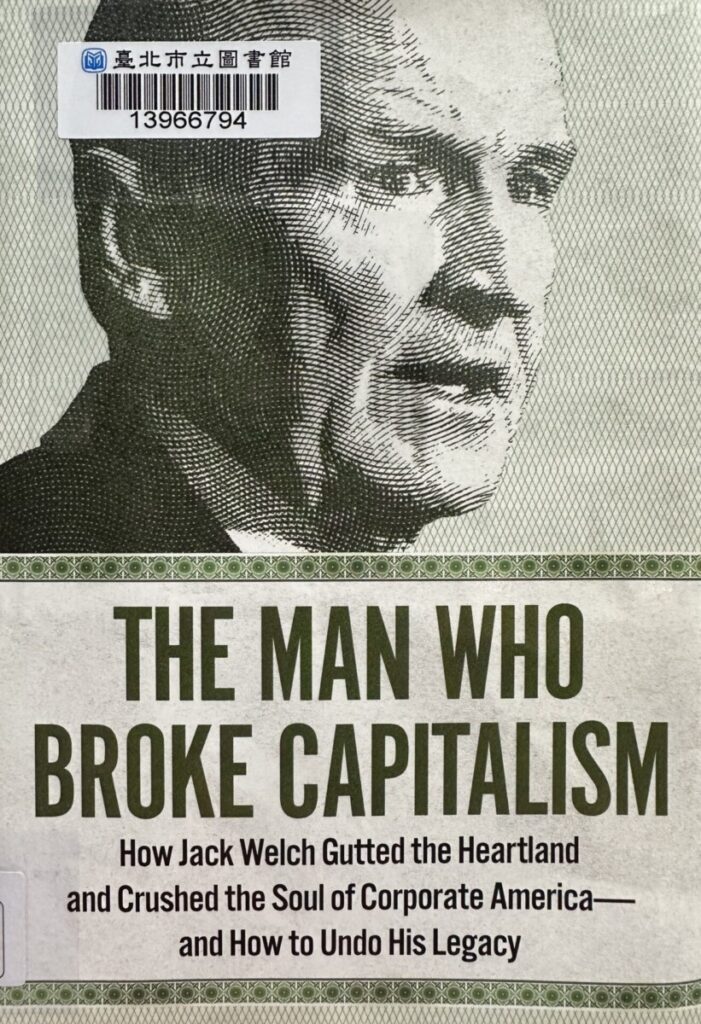
“Welch employed three main tools in his crusade: downsizing, dealmaking, and financialization. He is best known for the first of these. Upon taking over, he instituted a series of mass layoffs that destabilized the American working class….
When he couldn’t fire workers outright, Welch devised other ways to wash GEs hands of the responsibilities that come with being an employer. Welch championed offshoring and sent thousands of union jobs overseas to countries like Mexico, where labor was cheap. And he reveled in outsourcing, turning to other companies to provide back-office functions like accounting and printing…”
威爾許(在改造奇異電器公司GE時)採取三項主要的策略:精減人事、購併、金融化。他最為人所知的是精減人事。他一上任,就進行一系列的大規模裁員,打破了美國工人階級的穩定性…..
對無法馬上裁員的部分,威爾許採取其他措施來推卸身為雇主的義務。他把公司的生產基地移到海外,譬如勞動力便宜的墨西哥,減少成千上萬在美國國內的工作機會。他鍾愛業務外包,把公司的後勤支援,諸如會計及印刷的部門,都委由其他的公司來提供服務。
“The second main weapon Welch employed in his quest to make GE the world’s most valuable company was dealmaking. Through compulsive mergers and acquisitions, he transformed GE from a proud domestic manufacturer to a cash-spewing collection of unrelated businesses, unleashing an M&A boom that would extend well beyond GE and lead industries from media to finance to become more concentrated and less competitive. GE made nearly 1,000 acquisitions during Welch’s tenure, spending some $130 billion buying up companies. At the same time, GE sold some 408 businesses for about $10.6 billion. No company had ever done so many deals so quickly. The biggest of these took GE far from its industrial roots. Often, the deals were disasters. Sometimes, Welch quickly sliced up the companies he bought, then sold them off for parts. Yet even when the results were less than optimal, dealmaking served several of Welch’s greater goals. Welch wanted every business GE operated to be number one or number two in its respective category. If it couldn’t achieve that, it would be jettisoned. “Fix it, close it, or sell it,” he would say. By selling companies-even ones that were regarded as central to GE’s identity-Welch was able to retain only what he believed were the most profitable businesses, even if they had little to do with GE’s legacy manufacturing operations. And with his relentless acquisitions, he took out competitors and consolidated industries, gaining market share while pushing GE to expand in every direction imaginable.”
威爾許採取的第二項主要措施,就是透過購併,讓奇異電器變成世界上最有價值的公司。
透過強迫式的合併和收購,他把奇異電器由一個本土引以為傲的製造商,改造為由各種不相干的企業組成、充斥現金的集團。奇異的購併,在市場上一時蔚為風潮,使得美國的產業,從傳媒到金融,產業內的集中度變高而競爭性變小。
在威爾許就任期間,奇異電器共進行約1,000件的購併案,花了1300億美元在買公司上面。同時奇異電器也賣出了408個事業單位,收入約106億美元。有史以來從來沒有公司在這麽短的時間內完成那麼多的購併交易。
其中最大的購併案,把奇異電器從製造業的根本完全拔起來。經常,很多交易就是災難。有時候,威爾許會把剛買進來的企業切分,旋即分開來對外銷售。然而,經常這樣做並沒有更好,買賣的交易只是為了成就威爾許更大的目標而已。
威爾許要求奇異電器進入的產業,都必須是產業中數一數二的佼佼者,如果做不到他就會把它賣掉。他的口頭禪是:「搞定它,關掉它,不然就賣掉它。」
威爾許只在集團中保留他認為最賺錢的事業單位,縱使是傳統上代表奇異電器本業的公司,他也會賣掉,而至於和奇異電器工業生產的傳奇八竿子打不著的企業,他也會買進來。
透過瘋狂的購併,他消滅了產業中的競爭者,增加了集中度和市場佔有率,使得奇異電器向每個可能發展的方向擴張。
“The third dark art that Welch mastered was financialization. GE was an industrial company when Welch took over. By the time he retired, the company derived much of its profits from GE Capital, which was essentially a giant unregulated bank. Welch got the company into all manner of risky debt instruments, insurance products, and credit cards…”
威爾許的第三項改造措施是金融化。威爾許就任的時候,奇異電器是製造業。及至威爾許退休離開的時候,奇異電器大部分的利潤來自奇異資本,基本上是一家不受金融管制的銀行,從事風險性的債券、保險及信用卡的業務。
”But while Welch made GE the most valuable company on earth, his strategies ultimately destroyed what he loved so dearly. Not long after he retired, GE fell into a spiral of decline set in motion by Welch’s short-term decision-making. Within months of his departure, it became clear that GE was deeply troubled, and in a matter of years, the corporation was falling apart. His handpicked successor tried to replicate Welch’s success by following the same playbook, but it was a losing strategy. Welch’s underinvestment in research and development caught up with the company as it failed to introduce new, innovative products. A habit of incessant dealmaking resulted in a series of bad trades that burdened the company with money-losing divisions when it could least afford the losses. And the quest for ceaseless growth in the finance division led GE to become a major holder of subprime mortgages just in time for the financial crisis of 2008. At its nadir, GE needed a $139 billion rescue from the Obama administration and an eleventh-hour investment from Warren Buffett to stave off collapse. GE stock fell 80 percent in the years after Welch retired, becoming the worst performer in the Dow Jones Industrial Average. Finally, in 2021, executives announced a plan to break up GE, separating what was left of the company into three distinct corporations, and abandoning Welch’s world-conquering aspirations once and for all.“
成也蕭何敗也蕭何,當威爾許把奇異打造成世界上最有價值的公司的時候,他所實施的措施也適足毀了他是如此鍾愛的企業。
在威爾許退休沒有多久,他之前在任時的短視近利措施,就讓奇異電器落入衰退的惡性循環。他才離開沒有幾個月,大家慢慢發現奇異電器深陷在危機之中,而在幾年內分崩離析。
他親點的繼任者想要複製威爾許的策略,但是卻導致失敗。威爾許在任內忽略研究發展的投資,令奇異電器遲遲無法推出新的創意產品。習於不斷地購併,導致一系列不好的交易,在奇異電器最無法承受損失的時候,買進企業的虧損造成它巨大的財務負擔。
而在金融事業部門不斷成長的追求,使得奇異電器持有很多次級房貸,不幸適時碰上2008年爆發的金融危機。在最糟的時刻,奇異電器需要歐巴馬政府1390億美元的金援,甚至在瀕臨破產的最後時刻,必須靠Warren Buffett 的緊急投資來挹助現金。
在威爾許退休後的幾年內,奇異電器的股價跌了80%,成為美國股市表現最差的股票。最後在2021年,奇異電器進行瘦身分割,只留下3家公司,永遠完全放棄了威爾許征服世界企業的野心。
“In recent years, some business leaders have come to realize the damage that Welchism has wrought. Instead of pursuing profits at any cost, a new generation of executives is beginning to express a renewed commitment to serve not just shareholders, but all stakeholders, including workers, communities, and the environment. They recognize that if they don’t pay wages that create a strong middle class, the economy will ultimately grow weak. They understand that companies that leave their communities polluted and impoverished will wither before long. And by gently downplaying the importance of the stock market, they are even questioning the very measure of success that was so sacrosanct to Welch.”
近年以來,有些企業領袖開始明白威爾許主義(Welchism)所造成的損害。
他們不再不擇手段追求企業利潤的極大化,新一代的企業高層開始重拾以前的信念,不只是為了股東,而是要照顧到所有的利害關係人,包括勞工、社區及環境。
他們認為,如果不支付合理的薪資來支持中產階級,經濟成長的活力終將減弱。
他們明白,污染環境而且造成鄰近社區貧窮的公司在長期將無以為繼。
他們不過度在意公司股價的波動,甚至對威爾許自認為是企業經營成功典範的措施提出了質疑。
……
威爾許對員工的苛刻是十分有名的。每個單位,他都要求把員工每年的表現排名,而把排在末位10%的員工,全部資遣,完全不留情面。
投資奇異電器股票的投資人,如果及早下車,那是賺得滿鉢滿盆。但是如果不是呢?那就是虧得不能再虧了。如果說威爾許的原意是創造股東的最大利益,那麼他是用短視的近利換得了長期的巨大損失了,那適足是完全違反了他原來的本意。
美國總統雷根在1980年的總統大選中擊敗吉米·卡特,他和在1979年至1990年間擔任英國首相的柴契爾夫人,都鼓吹新自由主義,體現的是另一波更深度的「全球化」。這跟威爾許從1981年開始擔任奇異電器的執行長,是同一個時間的。
『……新自由主義一詞指的是一種政治與經濟哲學,強調自由巿場的機制,反對國家對國內經濟的干預、對商業行為和財產權的管制。在國外政策上,新自由主義支持利用經濟、外交壓力或是軍事介入等手段來擴展國際市場,達成自由貿易和國際性分工的目的。……』(維基百科)
如果說精減人事、購併、金融化是威爾許的發明,不如說他是在美國、英國政府所推動的「新自由主義」、「全球化」大纛之下,做得更早、徹底的美國執行長罷了。
2008年美國次貸爆發的全球金融危機,終於讓人看到了「新自由主義」、「全球化」的弊病了,造成問題的金融業CEO坐領高薪卻讓大家必須冒那麼大的風險,所謂的「肥貓」的議題,一時甚囂塵上。
美國CEO的平均年薪在1980年是185萬美金,到了2000年膨脹到2150萬美金,而在同期間,美國工人的平均薪資才增加12%。那麼威爾許會帶動精減人事、購併、金融化的風潮,不就是CEO自肥的過程嗎?
要追求股東長期最大的利益,就不能只看到對股東短期的最大利益,當如是觀之。
*:David Gelles, “The man who broke capitalism,” 2022, Simon & Schuster
2023/1/3 The man who broke capitalism Damakey
