
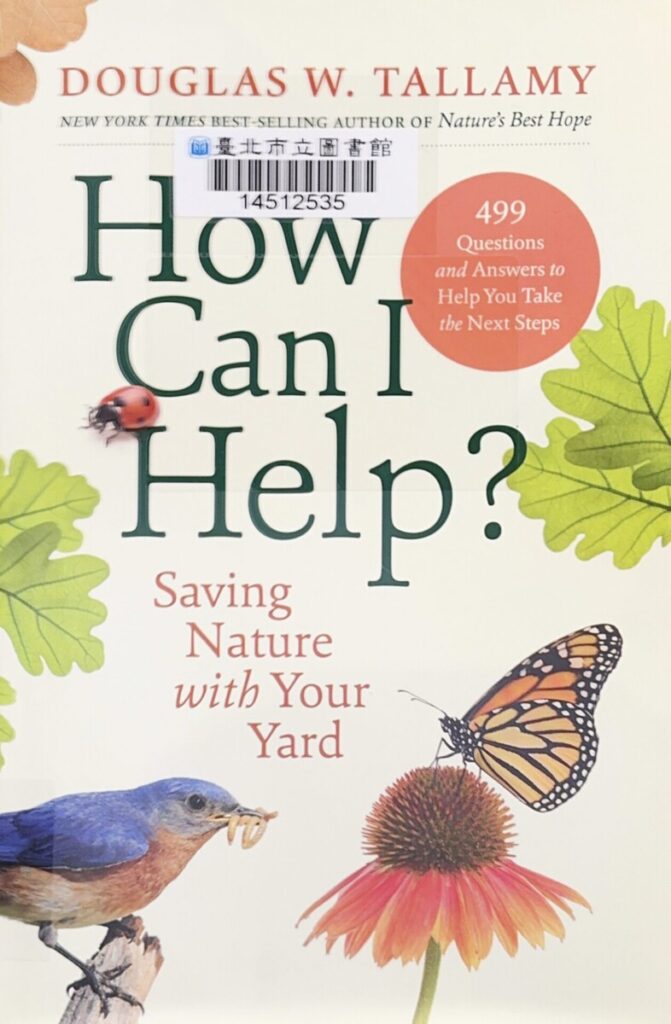
對生物多樣性(biodiversity)要有所貢獻,一般人就做得到,從自己家的陽台、前後院或頂樓平台,就可以做得到。
美國人住的洋房一般都有前後院,《How can I help? Saving Nature with your Yard》這本科普書的作者Douglas W. Tallamy,以美國的居家環境為例,建議美國人,只要在自己的院子𥚃種上當地的物種植物(native plant)就可以。
There is one enormous impediment to ecological landscaping that is a byproduct of the culture of private ownership: the misconception that your property is your discrete and isolated kingdom and you are king… From an ecological perspective, however, what happens in your yard does not stay in your yard. Everything we plant, don’t plant, or apply to our yard impacts the greater ecosystem in which our yard exists, and thus everything that depends on the ecosystem. For example, when we plant invasive plants, we are harboring ecological tumors whose offspring escape our landscape, negatively impacting our neighbor’s properties as well as the natural spaces around us. When we manicure acres of lawn, we diminish the ability of that land to reduce stormwater runoff, compromising the watershed in which we live as well as that of communities tens or hundreds of miles downstream. Planting large swaths of turf gras also wastes an opportunity to fight climate change. Filling our yards with turf grass, notorious for its ability to store carbon, not only does not remove carbon from the atmosphere, but it adds carbon every time we mow. Lawn care also pollutes local waterways with the unnecessary fertilizers and pesticides that are routinely applied to grass. When we overuse turf grass, we eschew our responsibility to support the food web that sustains local wildlife. Our plant choices, both in terms of species and quantity, determine how well our landscape support the diverse communities of native bees required to pollinate the plants that, in turn, are required for high-functioning ecosystems, as well as the insect herbivores that are the bread and butter of terrestrial food webs.
簡言之,以生態系的觀點,私人的土地並不是私人的土地。它上面生長的植物所形成的小生態系,會和周邊更大的生態系互動。在私人土地上種本地的植物,會吸引以本地食草的生物前來覓食,這是生態的公共財性質。
讀後
最近發現台北的二二八公園有部份的乾禿的林下,鋪回植物的落葉,感覺這是一種觀念的進步。
落葉本來最好就是自然回腐到泥土𥚃,營養回收到土壤𥚃,那樣植物才會長得好。拼命努力去掃掉,就是不斷抽離地下儲存養料而沒有回充,如果不加肥料,公園𥚃的植物長得不好,是可以理解的。
台灣私人的院子不多,但是應該也可以去種本土的物種,為環保盡力。
不要引進或養殖外來物種,逸出到野往往造成生態壓力,小花蔓澤蘭和綠鬣蜥就是有名的例子。
台灣的公園草地常常修得非常整潔,這也是可以改變的地方。應該可以考慮混種上本土的各種植物,不消幾年,就可以形成都會的小森林。
以台北人引以為傲的大安森林公園為例,草地就太多,「森林」兩字反而看起來顯得頗為諷刺。
大型高爾夫球場,就像Douglas W. Tallamy所指出的美國院子的草坪,只是那是放大版,對生物多樣性的危害,也是放大版的。
台灣中南部小黑蚊肆虐,那也是生態系的問題,田𥚃用了太多農藥,使得野外能食用小黑蚊幼蟲的動物大量減少所致。
防制蚊蟲傳染的登隔熱,要清積水。我記得台東有民宿,順勢而為,是在池子裏養青蛙和魚之類的,可以吃蚊子幼蟲孑孓。蚊蟲的數量因此得以控制。
面對生態,人類應該更謙卑一點,思考如何退後一步。自然生態有了空間和靭性,各種生態的傷口就會自動修復痊癒,包含傷在人類身上的。
對的,不要再種植和維護草坪了,把它們種上本土物種來形成都會小森林吧!
不要再掃公園林下的落葉了,我們眼睛的乾淨,其實是對自然循環的傷害啊!
然後,不要再建高爾夫球場了。不要打高爾夫球。
*:Douglas W. Tallamy, How Can I Help? Saving Nature with Your Yard, 2025, Timber Press, Workman publishing, Hachette Book Group, Inc., New York
2026/2/9 How Can I Help? Saving Nature with Your Yard Damakey
