
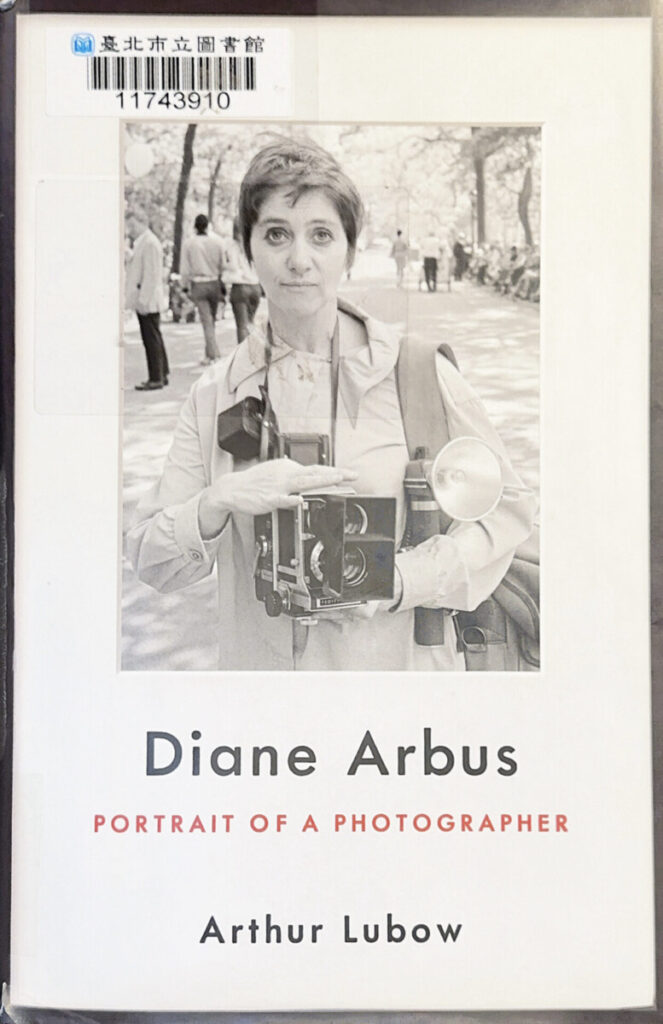
1971年7月26日,也就是距今(2024)53年前的同一天,攝影藝術紀實的先驅者之一的Diane Arbus,在長期受憂鬱症之苦之後,選擇用自殺的方式結束自己的生命。
一位攝影大師殞落了!
讀了桑塔格(1933-2004)的攝影經典《On photography》,循線續讀了Diane Arbus的傳記,對於攝影的本質,有了更基本的認識。
Diane Arbus喜歡拍攝各種的人物。她會和被拍照的對象親切互動,然後在適當的時機按下快門,因此往往能捕捉到隱藏在表象之下的秘密。
在Diane Arbus活躍的1960年代,底片很貴,相機的性能也還有待改進。但是,Diane Arbus與攝影對象的特別互動,使得她能捕捉到攝影對象個人的特色。
Diane Arbus所處的時代,也是是甘迺迪遇刺、越戰方酣、嬉痞處處充斥的變動性年代,她特別關注社會中處在邊緣的人,甚至被視為怪胎的侏儒、巨人、滿身刺青的人、脫衣舞孃等等,和當時時尚雜誌美美高尚的擺拍,形成極大的對比。有人甚至進一步引申,那代表Diane Arbus的攝影,石破天驚,一舉打破了階級的藩籬。
如果再深入去了解一下Diane Arbus的一生,我倒覺得,她的成就,不如說那是因為她對攝影無比的熱情所致。
Diane Arbus是猶太富商的小孩,雖然後來家道中落了,但在她成長就學的階段,可是有選擇性地上了最好的私立學校。老師發現她有繪畫的天分,她因此進入藝術學院。然而,她自己卻是痛恨繪畫的。
她千金大小姐的母親違抗父命嫁給一個窮小子,Diane Arbus也做了一樣的事,而且決心年紀輕輕就結婚。
她的父親反對無效,後來還延攬擅長攝影的女婿為家族企業的服裝生意拍照,甚至出資幫他們弄了一個暗房。
Diane Arbus是照相館擺拍的助理,後來她的先生Allan送給她一部相機,她到附近公園遛達的時候,就隨意開始為陌生人拍照。
有一天,她受夠了擺拍助理的無聊工作,不幹了,從那個時候,她就開始攝影的生涯,慢慢從業餘新手成為職業的專家,最終攝影成為一生的志業。
Diane Arbus的攝影最特別的地方是,她超級的親和力。她會和對方互動,問一些對方也可能重視的問題,然後在關鍵的瞬間,按下快門。
譬如,她拍侏儒,是先跟他們做朋友,成為他們的座上賓。她拍滿身刺青的人,則是不斷跟了好幾年,最後時機成熟才拍成的。這些都是很好的例子。
拍攝社會上比較弱勢的、邊緣的人,相片最後被出版,有人會覺得那是對那些人進一步的剝削。Diane Arbus 心裏並不是沒有那種掙扎,而且,很多照片雜誌社也因為有這些顧忌,加上怕被告,而忍痛割捨而不予刋登。
能夠讓Diane Arbus不斷攝影的動力,就是她對攝影無比的熱情。
1963年,她獲頒古根漢獎(Guggenheim Fellowship),成為古根漢基金會所支助的學人,變得更有名了,雜誌社提出的攝影構想,只要Diane Arbus同意的,就會直接委託給她。
然而,縱使是這種商業攝影,Diane Arbus也是專注地拍了又拍,希望引發出最好的作品。而這對模特兒是極大的磨難,雜誌社的人,往往需要從她的包包中把底片偷偷拿走幾捲呢!
正如跟她配合商業攝影的Turbeville 所解釋道的:
“She would build up a story about them. That’s why it was so frustrating to be on a sitting with her. It was an endurance process, while she tried to get herself excited and then to get a response from them. She would ask them questions. She would reveal something about herself and hope these people would react and then she would go from there and get more and more intimate until she’d slam a home run. She was trying to get as passionate as she could about the subject matter before her.”
從2024年的當下,去看Diane Arbus約莫一甲子之前那幾年的作品,依舊令人感到震撼。
有些攝影師偏好黑白的攝影。
但是,如果看Diane Arbus的攝影作品就能明白,黑白不是重點。重點是她透過與對象的互動,所能引發出來潛藏在表象之下的秘密。我相信如果用彩色的技術,Diane Arbus也可以說出很棒的故事,甚至更精彩。
一張攝影作品,是關於一個密秘的密秘,Diane Arbus如是說。(A photograph is a secret about a secret.~ Diane Arbus)。
Diane Arbus的攝影作品,既希望我們看到對象想要表達的自我,也希望讓我們也看到那對象想要隱藏的密秘。
這也是為什麼有些人被她拍了之後會不開心的原因。
剛好在7/26書讀到一個段落,記錄一下,向1971/7/26逝世的攝影大師Diane Arbus致敬了!
…….
《Diane Arbus Portrait of A Photographer》一書的部分內容摘錄如下,供大家參考:
Diane Arbus (1923-1971)的攝影作品,深受德國紀實攝影大師August Sander(1876-1964)的影響。
在August Sander的時代,用的是正色玻璃感光片(orthochromatic glass plate),雖然當時已經有全色玻璃感光片(panchromatic glass plate)的出現,但是由於正色玻璃感光片可以保留更多的細節,所以August Sander堅持採取舊的方法。
用正色玻璃感光片,必須曝光2-4秒,感光片又昂貴,每次只能拍上2-3張,所以August Sander 的作品,基本上是一種「擺拍」,透過主人翁與攝影師的合作之下,拍出主人翁認為最能展現自我的照片。
The people Sander photographed were types-representatives of the crafts, professions, political stations and family positions that had characterized German society for generations. It was Sander’s genius to reveal how particular individuals were protected, confined, fulfilled or devoured by their prescribed social roles. He began by collecting and conserving the images of an archaic rural society in Westerwald, near Cologne, the city to which he moved in 1910. From there, his scope widened. As he described it in a 1931 radio broadcast, he wanted “to capture and communicate in photography the physiognomic time exposure of a whole generation.” Classifying his subjects by profession and gender, he would organize the pictures systematically to make clear that “all carry in their physiognomy the expression of their time and the mental attitude of their group.” By the standards of this project, the sixty photographs in Face of Our Time constituted a mere sketch. There was something characteristically German in the grand, methodical ambition and the categorizing mania of Sander’s plan to expand on what Walter Benjamin, in an approving critical notice of Face of Our Time, called a “training manual” on the reading of facial types.
Sander 拍的人物形形色色——是世代德國社會匠人、專業人士、政治局和家庭成員等等的代表性人物。Sander 的天賦,就是能夠凸顯出特定的個人,他是如何被他既定的社會角色所保護、限制、表現或吞噬。自從1910年搬到科隆,他就開始蒐集並保存那附近韋斯特林地區原始鄉村社會的影像。從那兒,他逐漸加大範圍。正如他在1931年的無線廣播中所述,他希望「透過攝影捕捉並溝通一整個世代的長時曝光的人像」。把對象依職業和性別分門別類,他就可以把相片有系統地組織起來清楚呈現「那個特定群體人像的時代表情和心態」。依照這個專案的標準,在Face of Our Time 中的60張相片,只是輕描淡寫的幾張代表性作品。Sander 想擴大計劃,用德國式宏大而且有結構性的野心瘋狂蒐集,正如Walter Benjamin的正面評論,稱之為辨別臉型的「訓練手冊」。
“Entire stories could be told about many of these photographs, they are asking for it,” Alfred Döblin wrote in the introduction to Face of Our Time. That is indisputable, but it is also true that many, probably most of the stories would miss the target. In collaborative portraiture, the model and the photographer come together to produce a picture that expresses a shared confidence, a secret. Like all confessions, the photograph divulges only a part of the underlying reality, which remains in shadow or outside the frame. A record of a moment in which the photographer and model participated, the picture, Arbus felt, will always hold a private meaning for them into which others cannot enter. “I think it’s a secret probably for everybody’s pictures, that your own pictures mean more to you than they mean to anybody else,” she said. “Because it’s that thing of… I was there, and I saw that, and you may not believe it, and this is only an inkling of what it was like. But it really was. I was there. And it really was like that and now it isn’t like that at all.” A viewer standing in front of the photograph would have his own relationship with it, imbibing some of its mysteries, but for him, it could be only an evocation, not a souvenir. Each acutely observed and precisely recorded detail opens up new questions. Arbus might have been describing Sander’s work as well as her own when she wrote, near the end of her life, “A photograph is a secret about a secret. The more it tells you the less you know.”
「從這些相片可以敍述出完整的故事,應該說看照片故事就呼之欲出」,Alfred Döblin 在Face of Our Time的序言中是這麼寫的。那是沒有爭議的,但是有很多照片的故事並無法正確表現主人翁,那也是事實。擺拍的人像,模特兒和攝影師合作來產生一張相片,來表達一種雙方共同分享的自信,一種秘密。像各種的告解一樣,相片只透露現實的一小部分而已,還有更多是隱藏在暗影中或相片之外的。攝影師和模特兒共同參與的片刻紀錄,Arbus 認為,總是在他們兩個之間形成一種私密的意義,那是別人無法進入理解的。「我認為每個人每一張照片大概都有一個秘密,你自己的照片對你而言比其他人更具有意義」,她說,「因為那是那張照片特別的地方……我在那兒,而且我親眼所見,而你可能並不信服,這只是當時場景的模糊暗示。但那個場景是真的存在,我在那兒。那個場景當時就是那樣,但現在已經變得跟當時完全不同了。」 站在那張攝影作品前面的觀眾,和作品會形成自有的關係,接收到作品傳達的神秘,但只有他自己才能感受的,可能只是一種召喚,不是一種回憶。任何更仔細觀察到詳細記錄的細節都會引起新的疑問。Arbus 在這樣書寫的時候,她或許是既在描述Sander的作品,也是在說她自己的,在她接近生命的盡頭時,她寫道:「一張攝影作品是一個關於一個秘密的秘密。作品告訴你愈多,你知道的反而愈少。」
……
Diane Arbus 拍攝的對象,譬如(Google 一下就有很多照片可以欣賞):
Freak 怪胎
Eccentric people 社會邊緣人
Exotic people of circuses and sideshows
Dwarfs; midgets 侏儒
Tattooed man 刺青的人
Female impersonators 男扮女裝表演者
Male cross-dressers 男扮女裝
Nudist 裸體主義者
Identical twins 雙胞胎
Child 小孩
An old black woman 黑婦人
A Jewish giant 猶太巨人
Teenage couple 少年夫妻
Two ladies 兩位婦女
Muscle man 肌肉男
Strippers 脫衣舞孃
A beggar 乞丐
The mentally disabled 精神病患
Impoverished households 貧困的家庭主婦
The handicapped 殘障人士
…
Diane Arbus 是一個很坦率的人。有一次,為了賺取演講費用(在和另外一半分開之後,Diane Arbus靠攝影為生,在經濟上一向很拮据),她到佛羅里達州演講,分享了一個在裸體營𥚃拍攝一位祼男的故事。
她說依照規定,她也必須脫掉所有的衣服,她沒有想到掛在胸前的相機碰到身會感到那麼冰冷。
投影片放出的是那個裸男,焦距被刻意調糊了。當著台下很多學校重要的人物及該系的系主任,Diane Arbus 分享說:
“At the time, I was menstruating,” she said. “I had to be nude. When I was photographing this man, I was having my period and this man noticed my string was hanging out. And he said this was not correct in the context of the nudist colony.”
「那個時候我的MC來了,」她說。「但我必須全裸。當我為這位男士進行拍攝時,我正值經期,而這位男士發現了我的棉條繩露了出來。然後他說,依照裸體營字面上的要求,這不符合規定。」
Diane Arbus 深受憂鬱症之苦,但是她一直抗拒去看心理醫生。1969年的九月,就是在自殺的前兩年,Diane Arbus終於受不了,開始去看心理醫生 Helen Boigon。
根據自傳中所述,Diane Arbus跟心理醫生說得最多的是工作和性。她努力於讓自己在這兩方面都得到滿足,但都終歸於失敗。心理醫生說Diane Arbus對性完全無法感到滿足,就像肥胖的人對食物完全無法饜足一樣。
Arbus described going up to strangers on the street and propositioning them for sex. She spoke of answering ads in swinger magazines and bedding physically unattractive couples. She recounted sexual escapades on Greyhound buses and at orgies. She detailed episodes of sexual intercourse with sailors, women, nudists, and the Jamaican waiter. Most startling of all, she said in an offhand way that she slept with her brother, Howard, whenever he came to New York. It perturbed Boigon that Arbus told these tales without a trace of shame or remorse. The psychiatrist was mystified, …. Arbus viewed sex with moral neutrality…
Diane Arbus對心理醫生說,她在街上碰上陌生人,就會提議跟對方上床。她提到她會循著浪蕩雜誌的廣告和體格並不吸引人的夫婦同床。她細數越軌性行為發生的地方,包括灰狗巴士上和狂歡的聚會中。她詳細說明了各種性交的經驗,包括跟水手、女伴們、祼體主義者和牙買加的侍者。最令人驚訝的是,她順帶提到,每當她的弟弟Howard 來紐約,她也會跟她的弟弟睡。這令心理醫生Boigon很擔心,因為當Diane Arbus在說這些事的時候,居然完全沒有任何一絲的羞愧或懊悔。心理醫生感到不解…… 在Diane Arbus的眼中,性和道德是完全沒有關係的……
對Diane Arbus最大的認可,來自1971年五月號的Artforum雜誌,刋登了六張她的攝影作品,每張佔了整版,其中一頁還成了雜誌的封面。
Diane Arbus透過Metropolitan Museum 的館長Henry Geldzahler的介紹,和Artforum雜誌的創始編輯Philip Leider見上了面。Diane Arbus給他看了十張攝影作品,Philip Leider大為驚艷,馬上決定要刋登在Artforum雜誌上。
當時Modernism(現代主義)的大營,是以評論家Clement Greenberg 馬首是瞻,他們認為:
…a painter or sculptor should respect and exploit the capacities and limitations of the form in which it work. Since canvas is flat, for example, a painter mustn’t result to trickery that would suggest otherwise. He should emphasize the flatness…
大意是說,藝術創作應在該種創作形式和格式的限制之下追求極致的表現。
刋登在Artforum雜誌上,代表Diane Arbus的攝影作品,已經在其創作格式和格式的限制之下,達到了極致的表現,符合Modernism(現代主義)。攝影作品,正式被視為是一種藝術了。
編輯給了一整頁的篇幅,要Diane Arbus說明一下她的作品。Diane Arbus只寫了幾行,極富詩意的文字:
Nothing is ever the same as they said it was.
It’s what I’ve never seen before that I recognize.
Nothing is ever alike. The best thing is the difference.
I get to keep what nobody needs.
A photograph is a secret about a secret. The more it tells you the less you know.
中譯:
所有的事物都變得不再和當初他們所說的相同。
現在看到的是我以前不曾經看到的,這我承認。
沒有事物是曾經相似的。最好的事物是其間的不同。
我必須致力於保護沒有人要的東西。
一件攝影作品是一個關於秘密的秘密。它告訴你愈多,你反而知道得愈少。
……
寫得那麼好,難怪人家說,看Diane Arbus的攝影作品,一定要看她寫的標題和說明了。
Diane Arbus由一位攝影素人憑著對攝影的熱情在諸多攝影高手之間崛起,她對自己並不是永遠信心滿滿的。加上她起起落落的憂鬱情緒,Diane Arbus總是在自我貶抑和自我認同之間痛苦徘徊的。她也曾想過,是否算了,讓別人來拍那些主題吧!但是她後來繼續堅持下來,因為她覺得她可以拍出別人拍不出的效果。
在《Diane Arbus Portrait of A Photographer》這本自傳中,作者是這樣結語的:
Beneath her protective veil of self-deprecation, she acknowledged that what drove her as a photographer was the awareness that she produced pictures unlike anybody else’s. Contrary to common perception, the choice of odd subject matter is not what distinguished her. It was something bigger, deeper and subtler. “I do think I have some slight corner on something about the quality of things,” she said in an interview in 1968. There were times when she contemplated giving up the camera, relinquishing her subjects to others. “I mean, when I was very gloomy I thought that I could let somebody else photograph them,” she said. “You know, just call some very good photographer up and say why don’t you photograph this or this.” But gradually she had abandoned that notion. Her take on the world was unique, and she knew it. “Although I can’t defend this position,” she said, “I think 1 maybe do it because… there are things that nobody would see unless I photographed them.”
現在社交媒體上有大量的照片,有些照片擺明了是炫耀,而大部分的照片是要告訴別人自己的美好,甚至動用了修圖的軟體。從Diane Arbus的攝影理論和實務,照理說,從那麽巨量的照片之中,只要我們用心選擇去看,一定可以看到攝影對象想要表達的意思,也可以看到他們想隱藏在照片後面的秘密。
不用社交媒體的人,或者很少在上面分享自己照片的的人,應該是深諳這個道理的吧!
*: Arthur Lubow, 《Diane Arbus Portrait of A Photographer》 , 2016, HarperCollinsPublishers books
2024/7/26 向Diane Arbus 致敬 Damakey
