
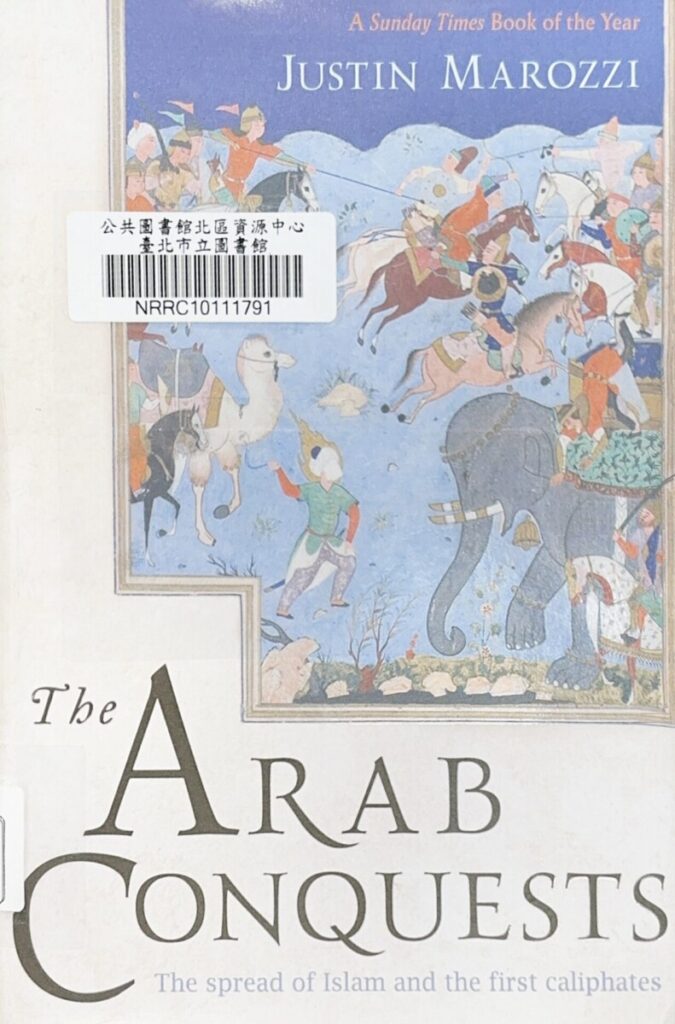
We know, for example, that the Arab Conquests followed immediately after the Prophet Mohammed’s death in 632. By this time, against all the odds, he had managed to unite the disparate, forever-feuding tribes of Arabia at the point of his sword. We know, too, that these great conquests lasted until 750, by which time several generations of marauding Arab armies had carved out an Islamic empire which, in terms of size and population, rivalled that of Rome at its zenith, extending from the shores of the Atlantic and the Iberian Peninsula in the west to the snowbound mountain passes of Central Asia and the borders of China in the east. In the process, they had completely crushed one great empire and hollowed out another.*
據我們的了解,譬如,阿拉伯人對世界的征服,緊接發生在先知穆罕默德於西元632年去逝之後。在那之前,克服了各種爭議,他已經使用武力,設法把各自為政而且不斷相互仇殺的阿拉伯部落,統一了起來。我們也知道,這些偉大的征服,一直持續到西元750年,到那個時候,經歷好幾個世代打家劫舍的阿拉伯軍隊,已經開創出一個伊斯蘭的帝國,就輻員和人口數而言,和羅馬帝國的鼎盛時期相當,疆域從西邊的大西洋岸和伊比利半島,到東邊中亞終年大雪覆蓋的山區孔道和中國的邊境。在這個過程之中,他們已經完全粉碎了一個強大的帝國,並從內部蠶食了另外一個帝國。
Ascendant for more than 400 years across Iran, Iraq, swathes of Central Asia, Anatolia and the Caucasus, the Sasanian Empire of Persia breathed its last under the Arab onslaught. In 651, powerless to repel rampant Arab forces swarming across his kingdom, unable to raise an army to protect his disintegrating empire, Yazdgird III was reduced to ignominious flight. After a valiant last stand near the ancient city of Merv, he abandoned his horse with its golden saddle, his mace and his sword in its golden sheath and took refuge on a pile of straw in a watermill. Here the man who revelled in the ancient title of Shahanshah, King of Kings, was treacherously betrayed and fatally stabbed by the miller. ‘This is the way of the deceitful world,’ wrote the peerless Persian poet Ferdowsi in his epic Shahnameh (Book of Kings), ‘raising a man up and casting him down. When fortune was with him, his throne was in the heavens, and now a mill was his lot; the world’s favours are many, but they are exceeded by its poison.” It was the end of the Sasanian dynasty and the demise of Iran’s last pre-Islamic empire. The country would never be the same again.
興盛長達400多年,地域跨越伊朗、伊拉克、條狀路廊的中亞、安納托利亞和高加索等等的薩珊波斯帝國,在阿拉伯的屠戮之下嚥了最後一口氣。西元651年,在無法驅趕帝國境內猖獗橫行的阿拉伯武力,加上無能召募到軍隊來保護分崩離析的帝國,伊嗣俟三世淪落於恥辱出逃。在莫夫古城附近堅忍對故國做最後一瞥之後,他遺棄了他的馬匹和金馬鞍、他的權杖和他猶插在金鞘中的劍,躲到一個水磨坊中的乾草桿堆中。這位以古老頭銜Shahanshah(王中之王)大出風頭的人,被背信忘義地出賣了,被磨坊主致命刺殺。「這是詐欺世道的運作方式」,舉世無雙的波斯詩人Ferdowsi在他的史詩Shahnameh(王者之書)中是這麼寫道的,「把一個人高高捧起,然後重重摔下。當他擁有財富的時候,他坐擁天堂的皇位,然後現在,一個磨坊是他僅有的小小空間;惠及世間的善舉所在多有,但是已經被傷害所遠遠超越了。」 薩珊王朝結束了,伊朗被伊斯蘭統治之前的最後一個帝國跨台了。這個國家將變得永遠和過去不同。
Further to the west, the Arabs had also ridden roughshod over vast tracts of the Byzantine Empire, seizing control of Egypt, its breadbasket, and North Africa, together with the fabled Holy Land in Syria and Palestine, while the God-fearing residents of Constantinople had trembled at the appearance of successive Arab armies – and even a fleet – before the city’s mighty walls.
再往西,阿拉伯人也蹂躪了拜占庭帝國(按:東羅馬帝國)廣大的區域,取得埃及的控制,這個帝國的糧食產地,和北非,以及聞名的聖地敍利亞和巴勒斯坦,當阿拉伯的武力不斷出現(甚至只是一艘船艦),接近縱使是固若金湯的城池,裏面篤信上帝的君士垣丁堡住民,都會不禁害怕顫抖。
…
Our story does not end with the conquests. Staring back through the ages at that momentous period from 632 until 750, we can see that it set the stage for a no less remarkable phenomenon – a cultural flowering in which the new-born Islamic world became the greatest, most sophisticated civilization on earth. Spiritually superior from its own perspective, it was militarily, economically and culturally pre-eminent from that of everyone else. Had it not been for the continent-spanning Arab Conquests, there would have been no Islamic Empire to champion and incubate the extraordinary intellectual advances in science, medicine, mathematics, astronomy, cartography, calligraphy, history, geography, law, music, theology, jurisprudence and philosophy that illuminated the world for centuries to come. Under the Abbasids, who in 750 replaced the Umayyads as leaders of the Islamic world from their new capital of Baghdad, Arab Muslims now studied astronomy, alchemy, medicine and mathematics with such success that, during the ninth and tenth centuries, more scientific discoveries had been achieved in the Abbasid Empire than in any previous period of history? Little wonder that this period has been likened to Greeces Golden Age of the fifth century BC.
征服並不是故事的結束。睽諸西元632年到750年那個充滿動能的時代,征服為卓越的風潮建立了一個舞台,文化的融合因而開花結果,新誕生的伊斯蘭世界,成就了當時全世界最偉大、最成熟的文明。他們自認為在精神上俱有優越性,而在軍事、經濟、文化上的傑出,也是無人能出其右。阿拉伯的征服如果沒有橫跨(歐亞非)大陸,那麼將沒有伊斯蘭帝國來追求和孵育出智識上卓越的進步,包括科學、醫藥、數學、天文、圖學、書法、歷史、地理、法律、音樂、神學、法理學、哲學等等各方面,在接下的幾個世紀,照亮了這個世界。阿拔斯在西元750年接替奧瑪亞成為伊斯蘭世界的首領,奠於新都巴格達,在他的治下,阿拉伯的穆斯林開始鑽研天文學、煉金術、醫藥和數學,並獲得重大進展,在西元九世紀和十世紀,阿拔斯帝國的科學發現和成就超過以往。這個時期會被類比為西元前五世紀的希臘黃金時期,也就不足為奇了。
…
The Arab Conquests were the midwife for the birth of a glorious new civilization, heir to both Rome and Persia. Having united an extraordinarily large landmass under the banner of Islamic rule, they set the stage for the Dar al Islam’s riposte to the Golden Age of Greece. ‘Seek knowledge even to China‘, ran one of the famous hadiths, and the Arabs took the Prophet at his word.
阿拉伯的征服扮演產婆的角色,順利催生了一個璀燦的新文明,上承羅馬和波斯。在伊斯蘭統治大纛之下,統一了非常廣袤的地域,建立了一個舞台,讓穆斯林居住區上演類似希臘的黃金時期。「追求智識,甚至不惜千里前往中國」,這是有名的聖訓之一,阿拉伯人顯然深信先知(穆罕默德)對他們所說的話。
Under the Abbasids of Baghdad, the Islamic world built on its rich inheritance from the Umayyads and became tolerant, pluralist, cosmopolitan, culturally rich, outward-looking and intellectually inquisitive, a trailblazer for new discoveries in which Jews and Christians, among many other communities, played an integral role. In a whirlwind of cultural development beginning in the late eighth century under the charismatic caliph Harun al Rashid, star of The Arabian Nights, Islamic civilization became the greatest and most sophisticated on earth. Landmark works of classical Greek, Persian and Hindu scholarship were translated into Arabic, revised, developed and improved, before being circulated around the Islamic Empire and far beyond. From Plato and Aristotle to Euclid and Hippocrates, knowledge passed from West to East and, through deep-pocketed Arab patronage, survived to pass back, centuries later, into Western civilization. Arab scientists, mathematicians, musicians, writers and poets, physicians, historians, philosophers, astronomers, legalists and lexicographers all beat a path to Baghdad and joined a cultural revolution that was every bit as remarkable as the conquests which had laid the foundations for it.
阿拔斯治下的巴格達,伊斯蘭的世界奠基於奧瑪亞留下的豐富文化遺產,社會充滿包容,接納異己,有世界觀,有各種不同的文化,向外看而不鎖國,追求智識,是新發現的先驅,而其中猶太教及基督徒,以及很多其他社群,共同扮演著不可或缺的角色。從八世紀後期開始鼓動的文化發展旋風,在充滿領袖魅力的哈里發哈倫·拉希德的支持之下,《一千零一夜》登場了,伊斯蘭成為當時世界上最偉大、最成熟的文明。標誌性的希臘、波斯和印度的經典學術作品,紛紛翻譯成阿拉伯文,並進一步獲得修訂、發展和增益,然後在伊斯蘭帝國內廣為流傳,並散佈到國外其他區域。從柏拉圖和亞理斯多德到歐幾里得和希波克拉底斯,知識從西方傳到了東方,透過財力雄厚的阿拉伯的眷顧,得到保護和保存之後又傳了回去,就在幾個世紀之後,往西傳回並注入了西方的文明。當時阿拉伯的科學家、數學家、音樂家、作家和詩人、醫師、歷史學家、哲學家、天文學家、法律學家、辭書學家都紛紛前往巴格達,共同參加這一場文化的革命盛宴,它對後世的卓越貢獻,完全不亞於為這場文化的革命奠下基礎的阿拉伯征服。
讀後
『伊斯蘭對中古歐洲的貢獻,影響廣及藝術,建築,醫藥,農業,音樂,語言,技術等不同領域。自11至13世紀十字軍東征及阿拉伯帝國崛起,歐洲便從伊斯蘭文明吸收各種不同的知識。尤其重要的是重新發現的古代經典文本,並經由東羅馬帝國輾轉帶回希臘及羅馬的典籍,最顯著的希臘哲學家亞里斯多德的著作通過阿拉伯語重譯,其也影響爾後文藝復興發展。』(維基百科)
『從11至13世紀,歐洲開始學習伊斯蘭文明的知識。 各種水果和蔬菜,在此期間通過中國和印度引進了歐洲,當中包括了朝鮮薊,菠菜,茄子。 還引進了在服裝和新材料方面的新技術,包括薄紗,塔夫綢及緞。 許多歐洲的樂器都受到阿拉伯樂器的影響。 西班牙的阿拉伯哲學文獻被翻譯成希伯來文,拉丁文,和拉迪諾,為現代歐洲哲學的發展作出貢獻。』(維基百科)
在西方的歷史中,大約從西元五世紀到十五世紀,被稱為歐洲的中世紀,由於各種因素,文化及各方面的發展相對於東方是遲滯的,因此一度被稱為歐洲的「黑暗時代」。
(歷史學家現在比較不傾向於這種「黑暗時代」的說法,但在那個時期東方的發展遠遠殊勝於西方,則是一個不爭的事實。)
相對地,從東方阿拉伯半島興起,由伊斯蘭先知穆罕默德的後人,繼續用武力征服而建立起來的阿拉伯帝國(西元632年-1258年),則是一顆照亮人類文明的璀燦新星。
阿拉伯帝國的興起,不早不晚是在拜占廷和波斯薩珊王朝長期戰爭,雙方正兵疲馬倦的時候。
雖然阿拉伯帝國是在西元1258年蒙古攻下巴格達之後正式滅亡,但其實它衰退的徵兆出現得更早。
和薩珊王朝一樣,阿拉伯帝國也陷入和拜占庭帝國長年的戰爭,以致阿拉伯帝國在九世纪末失去了伊朗東部的控制權,伊朗人在那兒建立了薩曼王朝(西元819年到999年),之後政權被突厥奴隸雇傭兵所篡奪,成為加茲尼王國。
西元1040年,塞爾柱的孫子打倒了宿敵加茲尼王國,並征服了伊朗東部的呼羅珊地區,塞爾柱蘇丹國(塞爾柱帝國前身)於焉誕生。
而塞爾柱人也是經常被阿拉伯人雇用的西突厥烏古斯族雇傭兵。
西元1071年,塞爾柱人攻下耶路撒冷,直接引發了第一次的十字軍東征。西元1194年,塞爾柱敗於花剌子模而滅亡。
在安那托利亞,塞爾柱帝國的延續政權是魯姆蘇丹國(西元1077-1307)。魯姆蘇丹國滅亡後,安那托利亞為諸小侯國所分治,其中興起的奧斯曼一世,也是屬於西突厥烏古斯族,建立了鄂圖曼帝國(西元1299年-1923年)。
鄂圖曼是透過長期不斷對外征戰所建立的大帝國。
西元1387年,鄂圖曼攻下威尼斯位於希臘愛琴海西北側的貿易重鎮塞薩洛尼基。
西元1389年,鄂圖曼終結了塞爾維亞對巴爾幹半島的統治。
西元1453年,隨著擴張至附近巴爾幹半島的土地,鄂圖曼攻下了君士坦丁堡,終結了拜占庭。
西元1514年,鄂圖曼擊敗了伊朗的下的薩非王朝。西元1543年奪取巴格達,但從此開啟和波斯長達300年的戰事。
西元1517年,鄂圖曼消滅了埃及由雇傭奴隸兵所成立的馬木路克王朝。
西元1521年,鄂圖曼征服了匈牙利王國。
西元1543年,鄂圖曼佔領神聖羅馬帝國的尼斯。之後和法國、英格蘭、荷蘭結盟,以共抗西班牙的哈布斯王朝。
西元1571年,鄂圖曼支持克里米亞攻擊俄國,但是失敗。(西元1853年,鄂圖曼則主要與英、法結盟,成功擊敗西進的俄國於克里米亞半島。西元2014年,俄羅斯佔領克里米亞。歷史,總是不斷重演。)
輻員廣大的鄂圖曼帝國,在19世紀的民族國家追求獨立的狂潮中,土崩瓦解,最後在第一次世界大戰戰敗之後的1923年,滅亡。
阿拉伯帝國、塞爾柱王朝和鄂圖曼帝國,都是由穆斯林所成立的龐大國家。這其中阿拉伯帝國及鄂圖曼帝國在極盛時期都是橫跨歐、亞、非三大洲的大帝國,在促進帝國內經濟發展和文化交流都有卓越的貢獻。這和中國地域廣闊的唐朝和元朝對人類史的貢獻,非常類似。
阿拉伯帝國和蒙古帝國類似,是由打家劫舍的方式崛起的游牧民族所建立的勢力。
信奉伊斯蘭的阿拉伯人面對異教徒,如果對方不願改宗只要繳人頭稅即可,做法十分實際而有彈性。而鄂圖曼帝國對異教徒的寬容也是有名的(似乎對安那托利亞什葉派回教徒的強力彈壓是一個例外)。
想想也對,一旦統治輻員變得很大,政策上只有廣納百川才比較可能長治久安。
希臘、羅馬的經典文化,在阿拉伯帝國,被翻譯成阿拉伯文而廣為流傳,使得那些經典文化恰巧得到保存,安度歐洲動蕩的中世紀,而在那之後則傳播回西方社會,進而影響到歐洲文藝的復興和文化的啓蒙,這是在21世紀回看七、八世紀的歷史,一個令人驚訝的歷史轉折。
西元八、九世紀興起的突厥人,尤其是那些阿拉伯人仰賴用來維繫權力的雇傭兵,他們的興起卻促使阿拉伯帝國走向了衰退,而蒙古的快閃入侵,可以說是補上了要命的一刀了。
依照一份報導,截至2023年初為止,全世界約有22億人是基督徒,接著第2名是約20億人的穆斯林。而依照出生率推估,穆斯林人數超越基督徒,在未來可以說指日可待。
在,“The Arab Conquests” 這本書最後,作者點出了穆斯林人口在阿拉伯帝國時代迅速成長的原因:
… And by definition, unlike Judaism especially, Islam was inherently inclusive. Conversion to the faith of the conquerors could be the matter of a few words in as many seconds. Islam, in other words, contained a built-in mechanism for expansion. It is difficult to imagine its subsequent global success without this defining, open-to-all feature. The reassuring familiarity of Islam, combined with the ease with which new believers could convert to it, proved just as important to the conquests as outright military might.
依照定義,不像猶太教,伊斯蘭教本身是充滿包容性的。改宗為征服者的信仰,只消說幾個字,只要幾秒鐘的時間。伊斯蘭教,換句話說,包含了一個內建的成長機制。很難想像如果沒有這種決定性的、開放的特性,伊斯蘭教的散佈在接下來於全世界可以獲得那麼大的成功。伊斯蘭教令人心安的熟悉性,加上對新教友改宗的方便性,證明和征服者所俱備無懈可擊的軍事力量,是一樣重要的。
……
愈世俗化,尤其是經濟的環境愈好,似乎有明確信仰的人數有逐漸變少的趨勢,這使得傳統上勢力龐大的教會,都會感到募款的壓力呢!
容易改宗,加上擁有出生率比較高的教友族群,不知伊斯蘭教在這方面是否比較不會有問題。
講到宗教儀軌的簡單性,佛教中的淨土宗,只要唸「南無阿彌陀佛」即可登西方極樂世界,不知是否又更簡單許多了呢?
但是,如果看到每年台灣的媽祖繞境,其程序之慎重和繁複,大量的信眾還是不辭千辛萬苦去持香拜拜或陪走上數百公里來看,那麼信仰本來就不只是「簡單」兩字而已。有時候反而是要有一種「難」。
基督徒的僧侶,不也是往自己的肉身上加「難」呢!
據說和穆斯林結婚的人,大致上也必須信奉伊斯蘭教(有些狀況可以例外)。至於這樣的「難」,倒是可以加強族群的內聚力了!
據說,全世界約有三分之一的人沒有明確的宗教信仰。
Pascal 說,既然不知道有沒有上帝,那麼最保險的是要相信是有的。
那麼沒有明確信仰的人,至少不是Pascal 說的那樣勉強相信的功利主義者吧!
*:Justin Marozzi, “The Arab Conquests,” 2021, An Apollo book
2024/5/20 The Arab Conquests Damakey
