
地球上的生命,在地球誕生後的5億年(40億年前)開始有了第一種最初的生命形態,單細胞的原核生物。20億年前,一個細菌跑到一個古菌中,細菌轉變為粒線體,產生了有機體的共生(symbiosis)的結構。依照內共生的理論,粒線體來自嗜氧細菌,而相對地植物的葉綠素,則是來自於藍菌。原核生物的專業分工,使得生物有機體的進一步變得更複雜成為可能。現在多細胞生物中,動物細胞中有粒腺體,植物細胞中有葉綠素,就是這麼來的。
原核細胞為什麼開始共生合作起來,沒有人知道,或許是一個意外。
而生物漫長的演化,基因的改變也是一次又一次的意外。
一顆落到墨西哥灣的星球,導致大部分的恐龍滅絕,為人類靈長哺乳類祖先的興盛清出舞台,在莫大的宇宙來說,機率微乎其微,也是一次的意外。
從地球生命發展的歷史來看,人類當今能持續的存在,是一連串意外所導致的。
現今地球的生態系,被人類影響之鉅,我們能夠依英國化學家James Lovelock 在1970年代提出的Gaia假說,認為在長期而言地球將自然回到均衡,主張生命有機體會和環境互動,所以整個系統會自動調整去保持對地球生命有益的各項條件嗎?
車諾比核電廠附近,強烈的輻射隔開了人類的活動,其他留下來的生物則欣欣向榮。如此看來,James Lovelock的Gaia假說,似乎言之成理。只是那自動調整之後的生存條件,不見得能繼續獨厚人類,我們忝然自稱的智人(Homo sapiens),如是而已,是吧!
地球生命發展的主要里程碑,條列於下供大家參考:
45.4億年前,太陽星雲凝聚形成地球,冥古宙(Hadean Eon)開始。
40億年前,冥古宙結束,月亮已經產生,流星對地球轟炸停止了,地面岩漿冷卻了。
40億年前-24億年前,太古宙(Archaean Eon):細菌、古菌(Archaea)等原核生物(prokaryotes),單細胞,最初的生命形態出現。
40億年前,藍菌(Cyanobacteria)這種原核生物,已經可以自行光合作用(photosynthesis)。
25億年前,元古宙(Proterozoic Eon)開始,植物出現了,也可能開始有了真菌(fungi)。
24億年前左右,地表產生出來的氧氣多過被吸收的,標示「大氧氣事件」的發生。
20億年前,一個細菌跑到一個古菌中,細菌轉變為粒線體,首創了有機體的共生(symbiosis)的結構。
20億年前到10億年前,地球生物在那漫長的10億年間,因為環境的刺激小了,演化也停滯了。
10億年前,單細胞的植物登陸了,
7.16億年前-6.35億年前,新的生命形式紛紛出現了,統稱「埃迪卡拉生物群」(Ediacaran fauna)。
5.7億年前,珊瑚出現。
5.4 億年前,元古宙結束前,動物出現了。
5.4 億年前,顯生宙(Phanerozoic Eon) 開始了,是我們現在所屬的時期。
5.4億年前-4.8億年前,「寒武紀大爆發」,這個時期已經開始出現的生命,包含海綿、水母、珊瑚、扁形動物、軟體動物、蠕蟲、昆蟲、棘皮動物(像海星這種動物)和脊索動物(有脊椎的動物,我們人類就是)。它們演化出多種生命的形態,被稱為「寒武紀大爆發」,突然增殖了很多有機體和物種。
4.3億年前,被子植物(開花植物)出現了,不必仰賴需要水的孢子來繁殖,植物可以長在陸地上。
4.3億年前,馬陸(millipedes)出現。
3.6億年前,樹木長出強壯的根系深入地下來固定自己,也穩定了土壤,開始長出木質的樹幹來支撐樹身。
3.12億年前,爬蟲類(reptiles)出現。
2.45億年前-2.22 億年前,系列的冰河時期。
2.4億年前,恐龍(dinosaurs)出現。
2.1億年前,哺乳類(mammals)出現。
1.5億年前,鳥類(mammals)出現。
6千4百萬年前,行星撞地球,「白堊紀—古近紀滅絕事件」(Cretaceous-Palaeogene extinction )K-Pg 或K-T,恐龍除了少數長羽毛的之外皆滅絕,人類鼻祖的靈長哺乳類興起。
2千4百萬年前,人科(Hominoidea)(類人猿apes)。
4百萬年前,人族(hominids),譬如南方古猿(Australopithecus)。南方古猿的後代是一個新的人屬(Homo)。
2百萬年前,巧人(Homo habilis)(會製造工具的人)
30萬年前開始,智人(Homo sapiens)興起,開枝散葉,從非洲開始散佈到南亞。
6萬年前,智人到達澳洲大陸。
4萬年前,智人回到歐洲。和智人同為人屬(Homo)的尼安德塔人滅絕。
2萬年前,智人到達北美。
13,000年前,人類世(Anthropocene epoch)的地質時代開始。
9,000年前,智人開始建造城市。
500年前,智人開始工業革命。
節錄“The Universe, A Biography”這本書中的相關章節於后,供大家參考:
Back on Earth approximately 4 billion years ago, perhaps a little earlier, the Hadean Eon ended…The Archaean Eon began and lasted until approximately 2.4 billion years ago. Most of what survive of the oldest rocks on Earth date from the beginning of this eon.
冥古宙(Hadean Eon)大約在40億年前結束,接著的是太古宙(Archaean Eon),一直持續到24億年前。目前地球最古老的岩石,大概就是在太古宙初期形成的。
……
Amid all this continuing geological turmoil, the earliest life winked into existence early in the Archaean Eon. It was in the simplest possible form of creatures (organisms with one cell without a nucleus, grouped together as prokaryotes, within which there are two subgroups: bacteria and, sitting by their side, a group named after the eon, Archaea. Archaea survive today – in abundance among the biota in the guts of all animals, for example, but also in extreme environments otherwise inimical to life such as hot springs or salty lagoons. They are hardy. If only Archaea could organize, we might think, they could compete for dominance of the planet, over all its surface and throughout geological time. In fact, they have organized, having come together in multicellular structures such as our species and others that compete for dominance today.
在地表大陸持續劇烈變動之時,最原始的生命突然在太古宙出現了。那是最簡單的生物(沒有細胞核的單細胞有機體,統稱為原核生物,又可進一步分成兩個子群:細菌以及古菌,而(太)古菌的「(太)古」就是以太古宙的名稱來命名的。古菌至今都還活得好好的,譬如在動物腸胃道的微生物群中數量就十分豐富,古菌也存在於對生命艱困的極端環境中,如滾燙的溫泉或鹽份含量高的潟湖。他們非常頑強。如果古菌可以團結起來,我們認為,他們能競爭而主宰整個星球,涵蓋所有的地表橫貫地質時間。其實,他們已經團結起來了,進駐多細胞生物體,譬如我們人類及其他的物種,一起競爭來主宰生態環境。
……
The earliest clear pieces of evidence of life on Earth are fossil stromatolites – columns of bacterial mats, fossils ……
地球最早的生命證據是疊層石化石——細菌毯形成的管狀物的化石……
Stromatolites are formed when microbes living in the sea known as cyanobacteria bind into organic-rich sediments or precipitate minerals in alternating layers. Because the microbes are photosynthetic, deriving energy from sunlight, they progressively move up through the deposited layers towards the light, forming new layers on top of the older ones. The older layers harden into rock that grows into a stratified column or even more complex structures. When fossil stromatolites are sectioned, they show a honeycomb-like structure as the plane of dissection cuts through draped layers of mats. Cyanobacteria survive to the present day and are commonly known as blue-green algae, sometimes appearing in abundance as an algal bloom during warm summers, even in British seas. Stromatolites persist even now.
疊層石的形成,是叫藍菌的微生物聚生在有機物質豐富的沈積物或礦物質的沈澱物之中層層疊疊而成。那種微生物行光合作,從陽光取得能量,它們逐漸從沈積層往有陽光的上方長,在老層上長出新層。老層硬化為岩石,形成層層的管柱狀或其他更複誰的結構。橫向剖開疊層石化石,呈現的蜂巢式的結構就像把地墊掛起來的橫切面一樣。藍菌截至今日都還活得好好的,一般被稱為藍綠藻,見於溫暖的夏日當藻類大量增生的時候,甚至亦見於英國鄰近的海域。疊層石至今依舊存在。
Cyanobacteria are bacteria that sit alongside Archaea as prokaryotes, monocellular structures that were the first forms of life……
藍菌是細菌,和古菌一樣都是原核生物,單細胞,最初的生命形態…
……
By about 2.4 billion years ago, more oxygen was being produced than was being soaked up in the surface of the Earth, marking the Great Oxygenation Event – for the first time the atmosphere contained free oxygen. It was less an event than an era in which the oxygen level gradually increased – for example, banded iron formations continued to be made, but only for about half a billion years in the deep oceans into which atmospheric oxygen did not at first penetrate.
大約在24億年前左右,地表產生出來的氧氣多過被吸收的,標示「大氧氣事件」的發生,有始以來在大氣層中有多的氧氣。僅次於氧氣逐漸增加的大事,譬如層狀氧化鐵層在那個時期持續形成,但是只消5億年的時間,大氣中的氧氣就開始溶到了深海𥚃面了。
At 2.5 billion years ago, the Proterozoic Eon had begun (the name means ‘early life’). Plants and, possibly, fungi appeared at this time. The upper reaches of the atmosphere formed an ozone layer that protected life on the surface of the Earth from ultraviolet radiation. At the end of the eon the first animals appeared. However, the development of life was held back by a series of global ice ages lasting from 2.45 billion to 2.22 billion years ago, even though the Sun had brightened and the Earth was receiving more solar warmth….
25億年前,元古宙(Proterozoic Eon)開始(「Proterozoic」的意思是「早期生命」)。植物出現了,也可能開始有了真菌。大氣的上面形成一個臭氧層保護地球的生命不受到紫外線的傷害。元古宙快結束的時候,第一隻動物出現了。但是生命的進程,因為在24.5億年前到22.2億年前之間一系列的全球冰河時期,而被延遲了,縱使當時太陽變得更亮使得地球接收到更多的太陽能……
This dramatic change of climate was triggered by the transition to an oxygenated atmosphere and ocean. The oxygen decreased methane levels in the atmosphere and increased carbon dioxide. Both are greenhouse gases but methane is much more effective than carbon dioxide. Reduction of the blanketing effect of atmospheric greenhouse gases caused the Earth to cool dramatically. Having combined with other gases, the concentration of oxygen in the atmosphere and the oceans reduced. This altered the balance between organisms that rely on using oxygen to metabolize and those that do not. Evolution hedged its bets by pairing organisms into a single organism that metabolized in two ways: one type, like cyanobacteria, metabolized through photosynthesis, the other used its waste products. Single-celled prokaryotes combined together into multicellular forms of life called eukaryotes.
氣候的劇變是因為大氣層和海中的氧氣逐漸變多所觸發的。氧氣降低了大氣層中的甲烷,而增加了其中的氧化碳。這兩種都是溫室效應的氣體,但甲烷遠比二氧化碳有效。大氧層保暖的溫室效應降低使得地球迅速變寒冷。和其他氣體混合的氧氣在大氣層和海中的濃度降低了,這改變了需要氧氣進行新陳代謝的生物體和其他不需要氧者之間生態的平衡。演化的壓力重新配對有機體成為單一有機體,分為兩種代謝方式:其中一種就像藍菌一樣,透過光合作用進行新陳代謝;另外一種則是利用前者代謝出來的東西。單細胞原核生物相互結合成叫做「真核生物」的多細胞生物。
This breakthrough formed the basis for much more complex organisms than those made of a single cell. Cells could readily develop into specialized forms that had different functions that nevertheless operated together to produce a very efficient fit to an environment. However, it took some time for this advantage to take off to full effect – the period from about 2 billion to I billion years ago shows few changes in species, geology or climate and therefore provided weak environmental stimuli to provoke evolution; it has been characterized in a term coined by English palaeontologist Martin Brasier as the ‘Boring Billion years’, the dullest time in Earth’s history.
這個突破形成生物由單細胞變成更複雜有機體的基礎。細胞可以先各別發展出特化的形態執行不同的功能,然後一起合起來運作,以有效地適應環境的變化。然而,過了很長的時間,這個效應才完全發揮——大約是20億年前到10億年前之間,物種、地理或氣候都沒有什麼改變,環境對演化的刺激很弱;那個時期被英國的古生物學家Martin Brasier稱為「無聊的10億年」,在地球的歴史中最沈悶的時期。
The Proterozoic Eon culminated dramatically in further Snowball Earth episodes, which took place towards the end of the period at about 716 million and 635 million years ago, and by the appearance of new forms of life, grouped together as Ediacaran fauna. Some were large and mobile, with muscular and neural cells, but no skeleton – walking mattresses. Others were tiny worms (like grains of rice)….
元古宙在冰封地球的事件之後,戲劇性地開始發光發熱,大約發生在接近元古宙結束之際,7.16億年前和6.35億年前之間,新的生命形式出現了,統稱「埃迪卡拉生物群」。有些長得巨大而且會動,有肌肉和神經細胞,但沒有骨骼——像會走動的床墊。其他的則是小蟲子(像殼粒一樣)……
The Phanerozoic Eon is the current eon on Earth and started 540 million years ago. The name is derived from the Greek words phaneros and zoe, meaning ‘visible life’, and refers to the sudden appearance of an abundance of readily identifiable fossils. It took approximately half a billion years for life to begin on Earth after its formation, but it remained very simple in its forms for a further 3.5 billion years. Once life became complex enough to be visibly modern, it took just another half a billion years for Homo sapiens to develop, as we shall see.
顯生宙(Phanerozoic Eon) 是我們現在所屬的時期,始於5.4 億年前。名稱取自希臘字phaneros 和 zoe,意思是「看得見的生命」,是指突然出現很多容易辨識的化石。地球誕生之後過了大約5億年才開始出現生命,但它在接下來的35億年都一直保持著很簡單的形式。一旦生命的形式複雜到看起來很進步,它只花另外的5億年就可以發展出現代人類。
The evolution of ‘visible life’ is something that needs first an organism to arise that is rather simple but then there is a rare combination of circumstances from which carbon atoms can combine in remarkable, complicated and self-replicating molecules and structures. It is a chain of events and developments that stretches from the energy-generating processes in stars that produced the carbon in the first place, through the provision of suitable life-favouring environments on planets, as a by-product of star formation, through the unique chemistry of carbon atoms and the positive feedback mechanisms of evolution to the variety of life on Earth today.
「看得見的生命」的演化,起頭的是比較簡單的有機體,但在一種很罕見的周圍環境組合之下,使得碳原子可以組成優異、複雜而且可以自我複製的分子和結構。那是一連串的事件和發展的結果,始於星球核融合過程之中產生了碳,然後在行星上必須提供適合生命生存的環境,而這是星球形成過程中的附產品,再加上碳原子的獨特化學性質以及演化的正向回饋機制才可達到今天地球上生物的多樣性。
Earth’s history is just one example of the way that intelligent life develops on a planet, but it is only one example and we should be wary of reading too much from it. Nevertheless, it appears that it is relatively quick and easy for life to start on a planet in a simple form, but it takes longer and it is more difficult for life to take the first steps into intelligence. One inference is that life might well be found on many planets in our Galaxy but there will be many times fewer that harbour extraterrestrial beings that we can talk to.
地球的歴史只是一個星球發展出智慧生命的方式的一個例子而已,但這只是一個例子,我們切莫過度解讀。儘管如此,似乎一個星球要開始有簡單形式的生命是相對快速容易的,但是要開始發展有智慧的生命則是需要更長的時間而且更困難。一種推論是,在我們的星系中可能可以在很多星球上發現生命,但是要能找到星球上有可以跟我們對話的外星人則是非常非常少的。
The life that first began on Earth in this eon includes sponges, jellyfish, corals, flatworms, molluscs, worms, insects, echinoderms (animals like starfish) and chordates (animals with a spinal column, like us). They evolved into a multitude of life forms in the event referred to as the Cambrian Explosion, a sudden proliferation of organisms and species. The fossils that established this transformation were found in rocks of the Cambrian period, named in 1853 by the Cambridge geologist Adam Sedgwick after Cambria (the Latin name for Wales), where rocks of this time are exposed in abundance.
在我們這個時期已經開始出現的生命,包含海綿、水母、珊瑚、扁形動物、軟體動物、蠕蟲、昆蟲、棘皮動物(像海星這種動物)和脊索動物(有脊椎的動物,我們人類就是)。它們演化出多種生命的形態,被稱為「寒武紀大爆發」,突然增殖了很多有機體和物種。透過化石建立的這個歷史性的轉變,發現在寒武紀地質年代的石頭中,「寒武紀(Cambrian period)」是在1853年由劍橋的地質學家Adam Sedgwick所命名,其中「Cambria」在拉丁文是Wales(威爾斯),因為在威爾斯當時發現了大量的寒武紀化石。
The Phanerozoic Eon began with life living in the oceans, then some animal species evolved from the shoreline onto dry land in response to the stimuli of varied and ever-changing environments as the tide went in and out. Unicellular plants had already moved onto land 1 billion years or more ago, but evolved into a more familiar plant form about 430 million years ago. At first, plants reproduced by distributing spores, which limited their distribution to swampy land because spores need moisture for the gametes to swim to meet together. Reproduction by seeds enabled trees to spread to make forests on dry land. Trees anchored themselves by growing strong roots into the Earth, stabilizing the land, and became tall by standing on woody trunks by 360 million years ago. This is the start of the geological period called Carboniferous because abundant forests laid down strata of carbonaceous material that became peat and then coal.
顯生宙的生命一開始是生活在海中,接著有些動物反映環境挑戰的刺激,潮來潮往,從海岸演化到乾地。單細胞的植物在10億年前就登陸了,但演化成現在我們比較熟悉的植物形態則是在4.3億年前。起初,植物透過孢子繁殖,但只限於分佈在沼澤地帶,因為孢子的配子需要有水才能游到一塊兒。透過種子繁殖使得樹可以在乾燥的地面形成森林。樹木長出強壯的根系深入地下來固定自己,也穩定了土壤,開始長出木質的樹幹來支撐樹身,這發生在3.6億年前。這開始了「石炭紀」,因為大量的森林木倒下在地層形成有碳的物質,之後變成泥碳,然後是煤碳。
Corals are marine invertebrates that first appeared in the sea about 570 million years ago. They built reefs that became sedimentary strata, sometimes of great size, like the present-day Great Barrier Reef in the Coral Sea off Australia, the largest living structure on Earth today, although only one coral reef of many. Other sea creatures deposited skeletal minerals that became rock strata of carbonaceous limestone and chalk, associated with strata of siliceous chert (flint). Life was creating new forms of rock, changing the very make-up and appearance of the Earth’s crust in a major way for the first time.
珊瑚是海生的無脊椎動物,出現在5.7億年前。它們形成珊瑚礁,形成沈積地層,有時候規模很大,譬如現今澳洲的大堡礁,是現今地球上最大的有生命的結構,而這只是諸多珊瑚礁之一。其他的海中生物所儲存在身體骨架中的礦物質,成為碳或白堊的岩石地層,和矽質煫石(煫石)一起。這是有史以來,生命開始創造出新的岩石,大幅改變地殼的打扮和外表。
The processes by which life drives forward the history of the Earth at the present time can be typified in the carbon cycle. Carbon is cycled through the atmosphere, rivers, lakes and oceans, and the crust. Carbon dioxide from the atmosphere dissolves in water, forming carbonic acid. This acid combines with calcium and other similar elements to make bicarbonate and carbonate chemicals. These compounds are taken up by molluscs for their shells and fall to the seabed when the molluscs die. They are buried in rock strata through which magma bursts from volcanic eruptions, releasing carbon dioxide through volcanic outgassing. Carbon dioxide is also exchanged from the atmosphere to the crust and back via the photosynthesis of plants and the breathing of animals. Dead organisms ferment and release carbon dioxide and methane, or may become fossil fuels like coal or oil. Human beings speed the fuels to return carbon dioxide into the atmosphere through industrial processes that have newly emerged in Earth’s history, starting three hundred years ago in the Industrial Revolution.
在現代,生命驅動地球歷史的程序,特徵是碳循環。碳的循環是透過大氣層、河流、湖泊和海洋和地殼。大氣層的二氧化碳溶於水形成碳酸。碳酸加上鈣和其他類似的元素形成重碳酸鹽和碳酸鹽。這些鹽類被軟體動物拿來打造外殼,而在它們死亡時沈入海底,埋入地層,透火山爆發的熔岩,二氧化碳經火山噴氣釋放。大氣中的二氧化碳也透過植物光合作用時吸收然後進入地殼,而動物在呼吸作用的時候則把二氧化碳呼回大氣之中。死掉的有機體發酵之後釋出二氧化碳和甲烷,或者變成煤或石油等石化燃料。而在地球晚近的歴史中,人類從300年前開始的工業化,加快了石化燃料中二氧化碳回到大氣中的速度。
In modern times, anthropogenic processes are on such a scale and so quick in their effects that they produce disturbances in the balance of biological cycles, which can be described under the general heading of ‘climate change’. The Gaia hypothesis originated by the English chemist James Lovelock in the 1970s suggests that in the longer term the planet will return to its equilibrium, proposing that living organisms interact with the environment so that the whole system self-regulates to maintain favourable conditions for life on Earth. It is a visionary, inspiring and hopeful perspective of environmental science, which, however, remains controversial as an unproved proposal.
在現代,人類相關活動達到的規模,加上其影響之迅速,已經打亂了生態循環的平𧗾,大家稱之為「氣候變遷」。英國化學家James Lovelock 在1970年代提出的Gaia假說,認為在長期而言地球將自然回到均衡,主張生命有機體會和環境互動,所以整個系統會自動調整去保持對地球生命有益的各項條件。這是一個遠景,很激勵且令人充滿希望環境科學的看法,可是這種看法未經證實而充滿爭議。
……
There were five mass extinctions during the Phanerozoic Eon, when large numbers of species died out, allowing new ones quickly to emerge. The causes of all of the extinction events are uncertain, and of some are very unclear. However, they all represent abrupt, globally widespread changes in climate, triggered by prolonged ice ages, extensive volcanic eruptions or violent meteoric impacts. The most widely known and perhaps best understood is the Cretaceous-Palaeogene extinction (previously known as the Cretaceous-Tertiary extinction). The name refers to the boundary between the Cretaceous and the Palaeogene (or Tertiary) geological periods and is abbreviated as K-Pg or K-T, with the K standing for the German word Kreide, meaning ‘chalk’, the rock distinctive of the time. The change of climate represented by the change of rocks above and below the boundary was caused by the impact of a large asteroid in the region now known as the Yucatán Peninsula of Mexico, which struck near the present fishing harbour of Chiculub (pronounced as ‘cheek-shoe-lube’).
在顯生宙共發生過5次大滅絕,大部分的物種滅絕了,讓新的物種迅速取而代,。所有大滅絕的原因都不確定,有些則非常不明。然而,它們都代表突然的遍及全球的氣候變化,由延長的冰河期所觸發,大量的火山爆發或劇烈的流星撞擊。最廣為周知的或許是被稱為「白堊紀—古近紀滅絕事件」(Cretaceous-Palaeogene extinction )(原稱為「白堊紀—第三紀滅絕事件」)。那個名稱表示發生在白堊紀和古近紀這兩個地質年代交接的時間點,簡稱 K-Pg 或K-T,其中K代表德文Kreide,是「白堊」,那個地質年代岩石的特徵。氣候改變所造成的影響,反應在那個流星撞擊的時點前後的岩石改變。現在知道那顆流星所撞擊的位置在今天墨西哥Yucatán半島接近Chiculub這個小漁村的附近。
…
These events of 64 million years ago caused a widespread extinction of many land-dwelling species. Most dinosaurs became extinct, although feathered dinosaurs survived, including some that evolved to become birds.
這些6千4百萬年前的事件造成陸上物種全面大量的滅絕。大部分的恐龍滅絕了,只有一些長羽毛的恐龍活下來,有些後來演化成鳥類。
Small, burrowing mammals also survived and moved to fill the gap in the environment left by the land-dwelling dinosaurs. Prominent among the mammals that eventually developed were Hominoidea (apes, originating 24 million years ago). The evolutionary line that developed from apes towards humankind branched off successively as gibbons, orangutans, gorillas and chimpanzees, and then hominids such as Australopithecus, who originated about 4 million years ago. These hominids developed stone tools and split into two parallel evolutionary branches, descendants of Australopithecus and a new genus, Homo. At first, Australopithecus and Homo coexisted in Africa but Australopithecus became extinct, leaving survivors that formed a lineage stretching into Homo habilis (man the toolmaker, 2 million years ago) and Homo erectus (upright man, I.5 million years ago). Migration spread H. habilis and H. erectus from Africa into Eurasia and southern Asia…The lineage of H. erectus from these migrations appears then to have foundered.
體型小的、會打洞的哺乳動物也活了下來,他填補了陸地上的恐龍滅絕之後所所留下來的環境空間。哺乳類中最著名最終得到發展的是人科(Hominoidea)(類人猿,源自2千4百萬年前)。朝人類演化的類人猿逐步分枝為長臂猿、猩猩、大猩猩和黑猩猩,然後是人族(hominids),譬如南方古猿(Australopithecus),源自大約4百萬年前。這些人族製造石器演化為兩個平行的分枝:南方古猿的後代以及一個新的人屬(Homo),他們活下來的形成的血緣包括巧人(Homo habilis)(會製造工具的人,200萬年前)、直立人(Homo erectus)(站立的人,150萬年前)。遷徙使得巧人和直立人從非洲遍佈到歐亞大陸和南亞……遷移到這些地方的直立人血緣後來似乎都消失了。
The most recent ‘out of Africa’ migrations of the genus Homo followed a similar migration track to that of H. erectus into Eurasia from 300,000 years ago. In these migrations, H. neanderthalensis and H. sapiens (modern humans) coexisted and indeed interbred. Neanderthals became extinct as a separate species of Homo about 40,000 years ago, but some Neanderthal DNA lives on in H. sapiens, which survived as the dominant and then sole human species.
最近期人屬「遠離非洲」的遷徒是30萬年前,循直立人類似的途徑進入歐亞大陸。在這些遷徙中,人屬尼安德塔人和人屬智人是混居而且混種的。尼安德塔人是人屬中的一個種後來在4萬年前滅絕了,但是有些尼安德塔人的DNA則還留在智人體內,繼續存活下來成為主宰最終變成人類中唯一的物種。
…
From 300,000 years ago, H. sapiens spread from Africa into southern Asia, reaching to Australia by 60,000 years ago and back into Europe by 40,000 years ago. The American continents were the most recent to be occupied by humans, with North America reached by 20,000 years ago, either by land travel from Mongolia and the now collapsed Bering land bridge southwards through Canada, or by a combination of sea and land travel to South America and northwards to North America, again over land. H. sapiens colonized the entire world (except for Antarctica) and began wreaking changes on the planet and its ecosystem.
從30萬年前開始,智人開枝散葉,從非洲散佈到南亞,在6萬年前到達澳洲大陸,然後在4萬年前回到歐洲。美洲大陸最晚近才有人類,在2萬年前到達北美,從蒙古及現在已經陷失的白令陸橋往西南方向穿過加拿大,或併用水、陸兩種交通方式來遷徙到南美洲然後向北經陸地到北美洲。從那時開始,智人就佔據了全世界(除了南極之外)開起對地球及其生態驚天動地的各種改變。
At first, humans were nomadic, following migrating animals, and, as in the case of the herds of mammoths that once roamed the North American plains and the Russian steppes, hunting them mercilessly and contributing to their extinction. This started the Anthropocene epoch in geology, in which specifically human life is a distinct force in the history of the Earth (the first part of ‘Anthropocene’ comes from the Greek word for ‘human’). An early trace of this era can be seen in the dense archaeological stratum of mammoth bones at the killing field in Clovis, New Mexico, one of the earliest surviving scenes of human activity in North America, 13,000 years ago.
起初人類是游牧的,跟著動物遷徙的腳步。以一度在北美及俄羅斯大草原徜徉的猛獁象為例,受到人類無情的大量殺戮終致滅絕。這開始了人類世(Anthropocene epoch)的地質時代,人類成為地球歷史上一股獨一無二的勢力(Anthropocene這個字的前段在希臘文字是human, 人類的意思)。人類世最早的痕跡可以從考古地層中猛獁象的遺骨看出來,位於新墨西哥州的Clovis,是13000年前人類活動所留下的最早期幾個殘景之一。
Gradually, humans switched their mode of living to become sedentary. They initiated agriculture, clearing forests to grow crops, replacing virgin forest with cultivated landscapes. Humans tamed rivers and lived in permanent settlements. From 9,000 years ago, humans built cities, adding man-made structures of a geological scale to the landscape. Within the last half-millennium, industrial activity began to alter the very composition of the Earth’s surface and its atmosphere. Humans changed geology, altering the shape of the land through large-scale activities of mining and civil engineering and the disposition and mix of its vegetation through land clearance and agriculture. With the population of H. sapiens exploding, human pressure on the habitats of other species has been leading to their decline and, in too many cases, extinction en masse.
漸漸地,人類選擇了更安定的生活模式。他們開始從事農業,砍掉森林來種植作物,把原始森林變成開墾的地景。人類馴化河川過起定居的生活。從9000年前開始,人類建造城市,增加人造的構造物成為地質年代規模的地景。在過去500年,工業活動開始改變地球表面及大氣層的組成。人類改變了地質,透過大規模的採礦和營造變更大地的形態,透過砍伐森林和農業來改變植物的組成。隨著智人人口的爆增,人類對其他物種棲地的壓力已經導致他們在數量上的衰退,而在很多的狀況,則是大規模的滅絕。
If we represent the biography of the Universe as a timeline that is as long as all the writing in this book, strung out into a single row, the Earth was born somewhere in the middle of the words of Chapter 7. Homo sapiens occupies the book’s last word or two, and human civilization less than the width of the last letter. Your lifetime, as part of that cosmic history up to the present moment, is represented by a small fraction of the last full stop.
如果我們把宇宙歷史的時間序列比喻為這本書的寫作,串成一整列,地球大概在第七章的文字中誕生。智人則只佔這本書的最後一個或兩個字,而人類的文明則不到最後一個英文字母的寬度。你的一生,比起磐古開天到現在,只是最後的那個句點很小很小很小的一部分。
*:Paul Murdin,”The Universe, A Biography,” 2022, Thames & Hudson Ttd, London
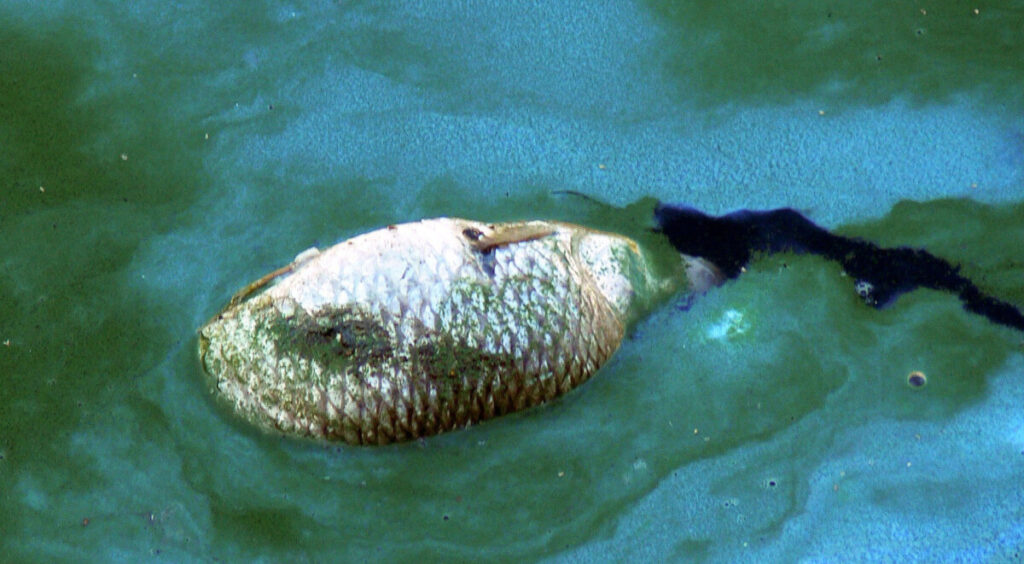
P.S. 照片為藍菌產生的毒素足以毒死魚(維基百科)
2023/2/23 人類是極為微不足道的存在 Damakey
