
什麼是Chandrasekhar limit (錢德拉塞卡極限)呢?
一個太大的星球是很不穩定,會核融合一直到變得夠小,大約就是像太陽質量的1.4倍左右,這個質量數值就叫做Chandrasekhar limit 或Chandrasekhar mass,名稱是為了記念首位算出那個數值的印度年輕數學家。
Chandrasekhar在計算白矮星質量和體積時發現,當質量接近Chandrasekhar mass的時候,理論上白矮星的大小已經縮到不能再縮,在物理上已經達到量子物理的極限了。如果繼續下去,就只有爆炸一途,白矮星邁向消亡。
而在數學上,那個臨界點叫「奇點」(singularity)。
節錄書中關於Chandrasekhar limit(Chandrasekhar mass)的介紹於后,跟大家分享。
閱讀Chandrasekhar limit (Chandrasekhar mass),深深覺得,白矮星不能超太陽質量的1.4倍,白矮星會有那麼一個「奇點」,我們平常如果被逼到絕境,不也是會爆炸嗎?物極必反,好像講的也是這樣的物理現象啊!
A star like the Sun with a mass up to 8 solar masses turns into a red giant star towards the end of its life, burning the helium that it has produced in its core. The helium is transformed to carbon and oxygen. This phase of its life lasts perhaps a billion years. The red giant star sheds its outer layers as a so-called planetary nebula. The residual core of the star then quickly turns into a white dwarf star, with a mass typically of o.6 solar masses but up to about 1.4 solar masses (the mass of the most massive white dwarf star so far discovered is 1.3 solar masses). Nuclear burning has ceased in such a star, which shines only by radiating the heat that it still contains from this earlier nuclear burning. It progressively cools, turning eventually into an all but invisible black dwarf.*
一個像太陽一樣的星球但質量高遠太陽的8倍者,會變成紅色巨星而步向死亡,不斷燃燒核心中的氦。氦轉變成碳和氧。這個階段大約持續10億年。紅色巨星剝除外層成為行星狀星雲。剩下的星球核心迅速變成白矮星,它的質量一般是太陽質量的0.6到1.4倍之間(白矮星中曾發現最重的是太陽質量的1.3倍)。白矮星的核融合已經停止,它的光亮是先前核融合產生的熱發出的熱輻射。它會逐漸降溫,最後變成一個看不見的黑矮星。
White dwarfs take their time to transform into black dwarfs – probably none in our Galaxy have ever made it to this stage yet. The dimmest white dwarfs known have a cooling age of 9 billion years. They typically have come from stars originally of about 3 solar masses, which took about 300 million years to become white dwarfs. Looking on the oldest white dwarfs as having come from the oldest stars in the Galaxy, this puts the age of the Galaxy as 9.3 billion years, at a minimum.
白矮星要很久才能變成黑矮星——或許在我們的星系中還沒有任何白矮星達到這個階段。最暗的白矮星至少已經歷經90億年的冷卻。它們一般是來自質量為3倍太陽的星球,歴時3億年才變成白矮星。視最古老的白矮星是來自星系中最古老的星球,那麼白矮星所在的星系它就至少是生成於93億年前。
There are billions of white dwarfs in our Galaxy: 95 per cent of stars end their lives in this way. However, although they are common, they are faint, so they are easily overlooked and none had been discovered until 1910. The first to be identified is called 40 Eridani B – the letter ‘B’ refers to the fact that it is the faint companion to the star 40 Eridani A, a binary star discovered by William Herschel (and further shown to be a triple).
在我們的星系中有數十億顆白矮星:95%的星球的生命是以此種方式告終的。然而,雖然它們是如此普遍,但它的亮光非常微弱,非常容易被忽略以至於從1910年至今再也沒有發現任何一顆。最早發現的編號40 Eridani B ,其中的字母“B”是指它鄰近40 Eridani A,William Herschel發現的雙星(後續觀察發現其實是三顆星球)。
Because it is in a binary system, it is possible to infer the mass of 40 Eridani B, which is not unusual and not very different to the Sun, at o.6 times the Sun’s mass. On a routine visit to Harvard College Observatory, American astronomer Henry Norris Russell(1877-1957) from Princeton University pointed out to Observatory director Edward Pickering (see page 41) that 40 Eridani B was abnormally faint. They discussed the consequence that it must be rather small – small stars have less surface area from which to radiate light, do not radiate much and therefore are faint – 40 Eridani B would thus seem to be abnormally dense, which implied that the structure of the star was different from others. Russell mentioned that it would be useful to know the star’s temperature so that its size could be properly determined – the amount of light per unit area radiated by a star depends on its temperature, so dividing its total luminosity by the light radiated per unit area leads to an estimate of the star’s surface area and hence a more precise determination of its radius. The Harvard Observatory was in the middle of a project to find the temperatures of large numbers of stars. Pickering made a telephone call to his assistant, Scottish astronomer Williamina Fleming (1857-1911). Russell recalled that ‘in half an hour she came up and said “I’ve got it here…”. I knew enough, even then, to know what it meant.’
因為它在雙星系統之內,可以推斷40 Eridani B的質量,並不特別不同也不會和太陽差不多,是太陽質量的0.6倍。來自美國普林斯頓大學的天文學家Henry Norris Russell,在一次到哈佛大學觀測站的例行性訪問中,向觀測站的主管Edward Pickering指出40 Eridani B 暗得不正常。他們討論那個結果的原因,認為一定是因為它特別小的關係——小星球的表面積較小輻射出的光不多所以顯得暗淡——40 Eridani B 的密度似乎異常高,使得該星球的結構和其他的星球不同。Russell提到或許可以偵測那星球的溫度,那麼就可以知道星球的大小——每單位面積輻射熱的大小和星球的溫度相關,把總亮度除了每單位面積的光輻射可以估計星球表面積,然後可以更精確決定其半徑。哈佛觀測站正有一個專案在偵測大量星球的溫度。Pickering打了一通電話給他的助理,一位蘇格蘭籍的天文學家Williamina Fleming。Russell憶及那件事情:「她在半個小時內回覆說,『有了。』在那個時候,我就知道那代表什麼意義。」
The temperature of the star was very high: it was ‘white’ hot. But it was also very dim, which meant that it was very small – a ‘dwarf’. Russell correctly surmised that the star was a similar size to the Earth, much smaller than the Sun or other similar stars although its mass was like theirs. The term ‘white dwarf’ for such a star was coined by Dutch-American astronomer Willem Luyten in 1922.
那個星球的溫度很高:是「白熾」熱。但是它卻很不亮,代表它很小— 是一個「矮」星球。 Russell正確推算出那顆星球的大小和地球近似,它比太陽或其它類似的星球都小很多,雖然它的質量和太陽或其它類似的星球近似。「白矮星」這個名稱用來指這樣的星球,最早是荷裔美國人的天文學家Willem Luyten在1922年取的。
White dwarfs are extremely small and dense – a matchbox filled with white dwarf material would weigh 1 tonne – and the force of gravity at their surface is very strong. White dwarf material is extraordinarily incompressible since it has to withstand the tendency of the star to collapse under its own weight. In 1925, a young British physicist, Ralph Fowler (1889-1944), using the new science of quantum mechanics, discovered that this material is ‘degenerate’: all the electrons in the material are packed together as closely as is physically possible, stopped from getting closer by the laws of quantum mechanics. The pressure generated in the degenerate material resists the tendency of the star to collapse, even given the strong gravitational force that drags it down.
白矮星體積極小而密度極高——一個火柴盒大小的白矮星物質重達1噸——而且在它的表面的重力則非常強。白矮星的物質完全無法再壓縮,因為它必須支撐住在自身的重量之下自然傾向的塌陷。在1925年,年輕的英國物理學家Ralph Fowler,運用新的量子力學,發現那是星球物質的「簡併」:所有的電子都擠在一起緊密程度達到了物理的上限,受到量子物理原理的限制。物質「簡併」所產生的壓力,抗拒了星球塌陷的傾向,縱使極大的重力在作用著。
Fowler’s discovery was incorporated into calculations of the structure of white dwarfs by a nineteen-year-old Indian mathematician Subrahmanyan Chandrasekhar (1910-1995). In 1930, he was on an ocean liner sailing from India to Britain to study at Trinity College, Cambridge, passing the time on the cruise around the Cape of Good Hope by making relaxing astrophysical calculations (unlike most other passengers, one may safely guess). Chandrasekhar discovered the relationship between the mass and the size of white dwarfs – he found to his surprise that the more massive the star, the smaller its size. In fact, he found that there is a mass at which a white dwarf would be point-like. Above this mass, white dwarts cannot exist, no matter how massive a star that they formed from. This limit is known as the Chandrasekhar mass and is about one and a half times the mass of the Sun.
當19歲的印度數學家Subrahmanyan Chandrasekhar在計算白矮星的結構的時候,Fowler 的發現被納入考量。在1930年,他搭乘洋輪由印度前往英國劍橋三一學院深造。在航程繞過好望角的時候為了打發時就著手進行航太物理的計算(不像大部分其他乘客,大家可想而知)。Chandrasekhar發現白矮星質量和大小之間的關係——他很驚訝發現,一旦白矮星達到一個特定的質量數的時候,它的大小則至一個點。超過那個質量數,白矮星無法存在,不管它是從多重的星球所形成的。這個質量限制,被稱為「Chandrasekhar 質量」,大約是太陽質量的一倍半。
A white dwarf star at the Chandrasekhar limit occupies just a point – an infinitely small volume, or in the language of mathematics, a ‘singularity’. If nature nears a mathematical singularity, it is heading towards a physical impossibility. Before the impossible is reached, nature diverts into some other realm. The new realm here is an explosion and, possibly, the creation of a black hole. Not everyone realized this at first. When Chandrasekhar presented his results to his colleagues in 1935, he was publicly ridiculed by the most distinguished astronomer in Britain at the time, Sir Arthur Stanley Eddington (see page 17), who called the result ‘stellar buffoonery’. Humiliated, Chandrasekhar abandoned his career in Britain and emigrated to the USA, where he worked at the University of Chicago for the rest of his life. His lifetime of achievement was recognized by the award of the Nobel Prize in Physics in 1983
‘for his theoretical studies of the physical processes of importance to the structure and evolution of the stars‘.
白矮星的質量達到「Chandrasekhar 質量」的時候,大小只是一個點——一個無限小的體積,或用數學的語言來說,是一個「奇點」。自然的本質特性接近數學上的奇點,代表它朝向物理上的不可能。在那個不可能發生之前,自然的本質特性就會導向其他的發展。而對白矮星而言,那就是爆炸,而且接著產生一個黑洞。一開始沒有人理解。當Chandrasekhar在1935年向所屬學院提出來的時候,被當時英國最有名的天文學家們公開嘲笑。Sir Arthur Stanley Eddington甚至說那個結論是「明星的滑稽表演」。羞辱之下,Chandrasekhar放棄了英倫的生涯搬到美國,在芝加哥大學工作並渡過餘生。他的終身成就終於受到認可,在1983年獲頒諾貝爾物理學獎,「因為他在理論上的研究,彰顯了星球結構及演變的重要性,促進洞悉物理運作的方式。」
*:Paul Murdin,”The Universe, A Biography,” 2022, Thames & Hudson Ttd, London
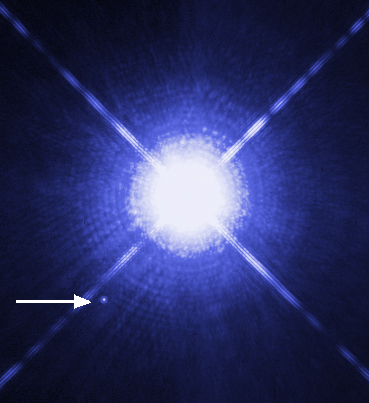
P.S. 相片哈伯太空望遠鏡拍攝的天狼星A和B。天狼星B是一顆白矮星,可以看到位在非常明亮的天狼星A左下方。(維基百科)
2024/2/21 白矮星有奇點,那你也有嗎? Damakey
