
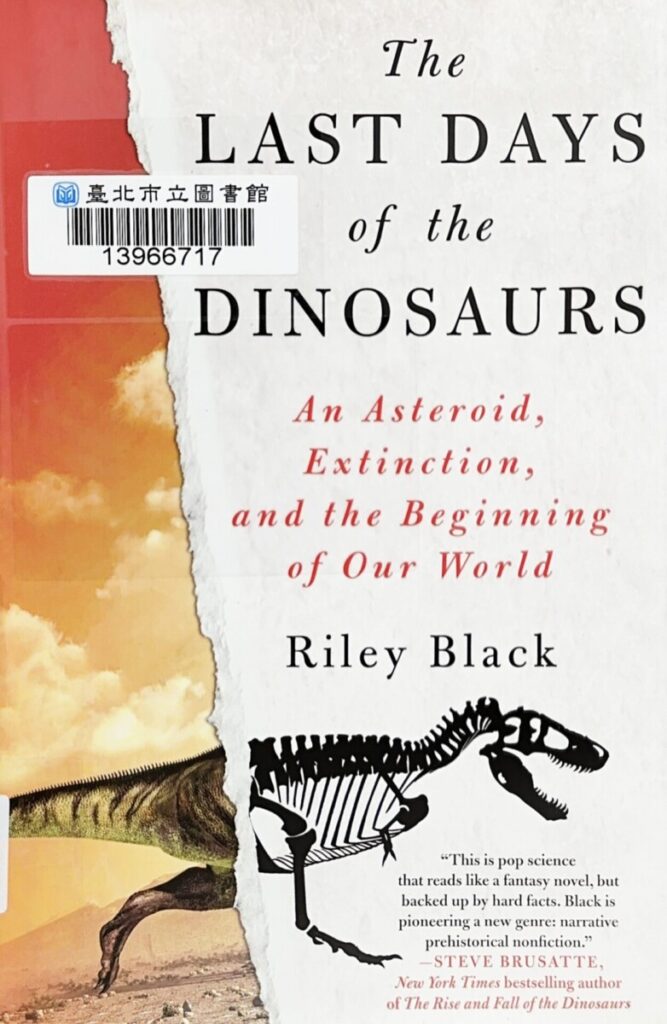
白堊紀(Cretaceous)是距今約1.45億年至6500萬年前之間的地質時期(維基百科)。
那個時候,開始有種子植物和靈長類的出現。
綜合而言,那是恐龍(dinosaurs)橫行天下的地質年代。
因為電影而令人耳熟能詳的侏儸紀(Jurassic,開始出現了鳥類),則在白堊紀(Cretaceous) 之前,期間為1.45-2.01億年前,可以說是恐龍最為興盛的紀。
白堊紀(Cretaceous)在地質年代的重要性,在於行星撞地球的事件,結束了它,造成地表約75%的物種滅絕,包括當時稱霸地球、形體龐大的恐龍。
這個事件也稱為K-Pg,K是白堊紀(Cretaceous)的德文Kreidezeit的縮寫,Pg是古近紀(Paleogene)的縮寫。
古近紀(Paleogene)的地質時期,在6600萬至2303萬年前,是緊緊接續在白堊紀(Cretaceous)之後那個紀。
行星撞地球的事件,結束了白堊紀(Cretaceous~K),同時開啓了古近紀(Paleogene~Pg),所以就稱該事件為K-Pg了。
K-Pg結束了爬蟲類(reptiles)稱霸的地質年代,開啓了哺乳動物(mammals)的地質年代,對於屬於哺乳動物的人類而言,可以說是意義非凡。
如果說沒有行星撞地球的K-Pg的偶發事件,就沒有今天如此興盛的人類,這可以說是毫不誇張的話。
“In the hours, days, weeks, months, and years following impact, almost every branch in the tree of life was lopped off, damaged, or struggled to grow. Even the organisms that we think of as survivors were not left unscathed. During the K-Pg catastrophe, there were mass extinctions of mammals, lizards, birds, and more, the ecological chaos touching the whole of life on Earth. From the foggy and sometimes dim windows of the fossil record, paleontologists have estimated that about 75 percent of known species that were alive at the end of the Cretaceous were not present in the next sliver of time. As if to drive the point home, a band of clay packed with the metal iridium marks the boundary between the Age of Dinosaurs and the opening chapters of the Age of Mammals. In some places, such as eastern Montana and the western Dakotas, you can follow the story layer by layer, watching the likes of Triceratops disappear as a world of diminutive fuzzballs begin to flourish in a new Age of Mammals….”
K-Pg之前,地球已經發生了4次物種的大滅絕。
“…The first extinction crisis, between 455 to 430 million years ago, reshaped the oceans, erasing entire families of archaic invertebrate weirdos and allowing fish to thrive. Rapid global cooling and plummeting sea levels killed about 85 percent of known marine species, reshuffling the evolutionary deck.
The second event, spanning 376 to 360 million years ago, shook life up once more. Precisely what caused the disaster is unknown–a drop in ocean oxygen levels is suspected-but the sudden change killed about half of known creatures, reducing the diversity among organisms like trilobites and corals that formed the basis of ancient reefs.
Worse still was the third, peaking about 252 million years ago. This was the Great Dying, fueled by incomprehensibly violent and sustained volcanic activity that wiped out about 70 percent of known species on both land and sea through climate and atmospheric changes. Our protomammal ancestors, who had held sway in terrestrial ecosystems, were almost entirely extinguished. Their downfall is what allowed reptiles, including dinosaurs, to stage their evolutionary coup.
Following that, about 201 million years ago, another disaster killed off a great number of the crocodile relatives that ruled the land and gave dinosaurs their shot at dominance. Once again, intense eruptions were to blame. Greenhouse gases belched into the atmosphere, spurring a burst of global warming followed by intense global cooling. Atmospheric oxygen levels dropped, the seas became more acidic, and the drastic shifts between too hot and too cold were too much for many species to cope with.”
第1次物種大滅絕,發生在4.55-4.30 億年前。地球急速冷卻加上海平面下降造成85%的水中生物滅絕。
第2次物種大滅絕,發生3.76~3.60 億年前。具體原因不明,可能是海水含氧量遽降,殺死了50%的水中生物,降低了岩礁中三葉蟲、珊瑚等等生物的多樣性。
第3次物種大滅絕,發生在2.52 億年前。由於火山的持續噴發,滅絕了海中和陸地上70%的物種。我們哺乳類的祖先幾乎完全滅絕,爬蟲類因此堀起。
第4次物種大滅絕,發生在2.01億年前。火山持續噴發,全球暖化接著的全球冷卻。空氣中含氧量降低,海水酸化,氣溫在極熱和極冷間交替,滅絕了很多物種。爬蟲類中鱷魚的消退,為恐龍的興起佈好了舞台。
第5次物種大滅絕,發生在0.66億年前。 因為行星撞地球,恐龍退出舞台,由哺乳類接手主宰地球。這就是有名的KP-g事件了。
第5次物種大滅絕和前4次物種大滅絕,有很大的差別。前4次物種大滅絕,發生的時期跨越好幾百萬年,有些物種還有機會去逐漸調整適應而存活下來。但是第5次物種大滅絕,則是在行星撞上地球的那個瞬間就發生了天翻地覆的改變,地球上的生物可以說是被殺得措手不及。
“…Dinosaurs appeared toward the middle of the Triassic, about 235 million years ago, flourished in the Jurassic, and kept their influential hold on terrestrial ecosystems through the Cretaceous, spanning over 160 million years as the most charismatic animals on the planet…”
恐龍開始出現在三疊紀(Triassic)中期,約2億3千5百萬年前,盛於接下來的侏儸紀(Jurassic),直到白堊紀(Cretaceous)都還一直主宰著陸地上的生態圈,持續共長達1億6千萬年。
“…Mass extinction events are destructive, but they do not necessarily spur new growth by themselves. In fact, some of the grandest moments in evolutionary history -when life truly burst forth and filled the world in ways never before seen–were not at all connected to mass extinctions. Nature’s greatest flowerings have often come from evolutionary accidents and happenstances dealing with organisms themselves, such as the ancient time when fish with legs began to crawl out onto soaking mudflats and plowed a life at the water’s edge. Life was no longer confined to water by this time, but vertebrates munched on insects and plants that had already made their homes on land, changing to meet a new environment and eating new prey, leading to a burst of adaptation.”
大滅絕並不必然導致新的生長。其實,在演化的漫長歴史中的重大改變,經常是來自意外的偶然。開花植物的出現和魚類用鰭爬出水到成為陸地上的生物,都是絕佳的例子。
“Mammals have enjoyed their own heyday during this time. Perhaps that sounds strange. Traditionally, mammals are cast as evolution’s underdogs, tiny beasts that squeak out a living eating bugs during the twilight hours when dinosaurs begin to doze. The stereotypical image is of a tiny shrew gnawing on a prehistoric cricket. But the earliest mammals evolved about the same time as the first dinosaurs, and they’ve been thriving alongside the saurians. True, they’ve never gotten larger than the size of a house cat in all these millions of years, but they are not all timid insectivores. In the shadow of the dinosaurs there have been mammals that look and behave like prehistoric beavers, flying squirrels, aardvarks, raccoons, and more. They did not evolve because dinosaurs ceded any ecological space for them to arise. To the contrary, mammals evolved to take advantage of ecological opportunities at a small scale. The evolution of social insects like termites, for example, provided a food source for mammals capable of digging into soil and rotten logs. The sheer number of baby dinosaurs on the landscape each season led to the evolution of predatory mammals that ate eggs and reptilian infants. Tall forests, with canopies too high for even the biggest predatory dinosaurs to reach, provide refuge for mammals…”
哺乳動物是跟著恐龍一起演化的。
雖然受到位於生態圈主宰地位的恐龍的抑制,但哺乳動物卻能見縫插針,甚至能長到像家貓一樣大。
白蟻成了哺乳動物食物的來源,遍地的恐龍蛋和剛出生的小恐龍也是。在體型巨大的恐龍搆不到的樹冠,就成為哺乳動物安全的棲地。
“The fires are only the insults to a deeper ecological injury…There are no signs of fire on the dinosaur’s body, not a filament or scale blackened. But the terrible heat had been too much to cope with. The re-entry of the impact debris created a global infrared heat pulse that lasted for hours. That energy alone was enough to raise the air temperature to 500 degrees Fahrenheit. The air itself can burn.”
行星撞地球之後引發大火,氣溫持續在華氏500度(攝氏260度)的超高溫。
“But the asteroid impact was so great that there was no place on the surface of the Earth that was truly safe. Life on Earth had become reliant on oxygen in the atmosphere billions of years before. So when the air itself became deadly, there was little that could be done for terrestrial life…any dinosaur out in the open quickly died, and fires flared over most of the world. The impact did not just send burning debris a few miles away or to the nearest continent. Sparks for the global flame spread all over the planet. The ancient Americas saw the worst of it, partly because of their proximity to the point of collision, but the effects were so dire that even on the other side of the planet, extinction still arrived nearly as swiftly. And as the first day of the Paleocene closed, the terrible events of the that day had only set the backdrop for the creeping, seemingly interminable struggle to come.”
地球上的生物皆需要充足的氧氣,行星撞地球之後,空氣變得很糟、很致命,陸地上的生物可以說皆無處可逃。
在空地上的恐龍,都迅速死亡。
全球的大火,使得縱使在撞擊地另外半球的生物,也很快面臨了滅絕的命運。
“Even though more than half the Cretaceous species are now vanquished, not all the dinosaurs perished in the initial heat pulse and subsequent fires. Avians fared the best; some managed to burrow or find shelter from the infernos, emerging to find a world where the giants had all disappeared. And a few straggling non-avian dinosaurs survived, too.”
雖然有泰半的白堊紀物種在K-Pg發生之後迅速滅絕,但是並不是所有的恐龍皆死絕。會飛的恐龍以及會挖洞躲避高溫的恐龍,能存活下來,但是身型都是相對較小的。
“Such a second reign of the dinosaurs is not to be. The target rocks that the bolide struck had been formed in ancient seas millions of years before. Known as marine carbonates, the rocks at the point of impact were what was left of a warm, shallow sea that hosted great reefs entirely packed with life. Colonies of corals grew into tiny empires in the sunlit waters. Small, armored amoebas known as foraminiferans proliferated as plankton, along with disc-covered algae called coccoliths. The rock that was eventually left behind by these waters was not principally made up of sandy sediment, but was largely composed of the shells these planktonic creatures so assiduously grew to give themselves protection and shelter. Changing sea levels eventually caused the little patch of ocean to dry up. The waters receded, the seawater evaporating and leaving behind vast amounts of salt crystals-codified in stone as anhydrites. The principal chemical composition of these transformed salt crystals is calcium sulfate, CaSO4. It’s the latter part that’s most concerning for the creatures of the Paleocene.”
但是,恐龍的地質年代已經一去不再回來了。
行星撞擊的岩石,並不是沙土的沈澱,而是由珊瑚、有孔門的浮游生物、鈣板藻片等等生物產生的硬外殼,在海平面下降之後,乾燥鹽化的結晶,在岩石中被稱為酸酐。另外在鹽化的結晶中,主要的化學成份是硫酸鈣,這對KP-g之後的古近紀(Paleogene)生物,有特別的意義。
“While the weeks and months immediately following the impact and the great infernos saw dark skies clouded wish to, the persistent darkness has lifted now. Sunlight touches Hell Creek once again. But it’s not the same as it was a year before. The sulfates that remain in the atmosphere, still stirred around by air currents miles up from the planet’s surface, continue to reflect a great deal of the incoming sunlight back out into space. Together, they diminished the amount of sunlight reaching the planet by about 20 percent.”
飄在空氣中的硫酸鹽反射了陽光,使得抵達地表的陽光,少了大約20%。
“The plants with the best chance are those that evolved to tolerate low-light condition, those often kept in the shade by taller trees of the Cretaceous world or that otherwise, by sheer luck, could get by on less. Low to the ground, a small, spindly branch pokes up from the soil…”
能適應的植物,都是比較矮小的,或者能善用低照度者。
“…It’s a bird, or an avian dinosaur–one of the few survivors of the dinosaurian family. Even compared to some of the birds that shared the Late Cretaceous world, the bird is on the small side. The time of giants is over…”
在恐龍家族中,會飛的恐龍存活了下來,它們成為鳥類的祖先。但是比起其他會飛的恐龍,存活下來的體型都比較小。
“The sulfates thrown high into the stratosphere did more than reflect back the nourishing sunlight that had been taken as a given by Earth’s organisms for so many millions of years. The aerosolized sulfur from the target rock often combined with oxygen in such a way to create sulfur trioxide. Strewn about by air currents, the compounds remained in the air as rain clouds formed. Typical rain has a pH of about 5.6, a fact that life on Earth had become accustomed to during its long evolution. But this rain contains sulfuric acid, enough to drop the pH of rain to about 4.3.”
硫酸鹽飄到平流層(同溫層,約在地表7-50公里的高空),不只反射了陽光,氣化的硫酸鹽氧化之後產生三氧化硫(SO3),在雲中和水混合可以變成硫酸(H2SO4),使得雨水的酸鹼質(pH)接近強酸的4.3,這就是酸雨。
“The rain doesn’t melt organisms on contact or hiss and sputter when it hits the ground. In fact, acid rain isn’t even as acidic as lemon juice. But it’s enough of a drop in pH that lakes, ponds, and oceans become more acidic as they collect the altered raindrops. Organisms that rely on shells for protection cannot build them as reliably. And on land, plant life becomes discolored- turning sick shades of rust brown–as chemical reactions within the soil eat away at the nutrients trees and other vegetation need to grow. It’s a slow, nearly invisible process, subtly altering the conditions of life that Earth has become accustomed to. The rain took the sulfates out of the atmosphere, offering some hope that the sunlight might return sooner, but at a terrible price to the world below.”
酸雨在湖泊、池塘和海中的濃度漸漸變得更高,這會腐蝕生物用來保護身體的外殼。酸雨會融解土壤中的礦物質,造成賴之以生存的植物營養不良。
“The shells of the bivalves and mollusks that lived on the ancient seafloor were principally made of calcium carbonate, CaCO3. Calcium carbonate reacts with sulfuric acid, the chemical dance between the two buffering the effects of the acid and neutralizing it. For living animals, that can be bad news. It’s hard to make a home out of shell when that shelly material is being eroded as you make it. But the shells in the limestone are from creatures long dead, and so the fossils are a boon to the Paleocene animals that are still hanging on….”
在古老海床雙殼貝及其他軟體動物所遺留下來的殼(會形成石灰岩),主要成份是鹼性的碳酸鈣(CaCO3),可以和酸雨中的硫酸(H2SO4)產生中和反應,在某些地區有效緩解水質酸化的壓力,石灰岩化石對還在生存邊緣掙扎的古近紀動物而言,是莫大的恩賜。
“Not every place is so sheltered. There is little escape from the acid rain for organisms that live in the soil. Worms can move, but bacteria, fungi, plants, algae, lichens, and other forms of life can only grow, die back, and grow as best they can in response to the changing conditions. And it’s within these soils that the record of this extreme disaster has come to rest.”
並不是每個地方都可以找到庇護之所。在土壤中的生物就無處可躲。蟲還可以爬走,但是細菌、真菌、植物、藻類、蘚苔等等生命型態,只能在原地自生自滅。
“…Topographically dramatic as it might be, a mountain is an erosional environment. It is a place where water, wind, sunlight, and other natural forces are winnowing away at the towering stone, pieces constantly carried downhill to the lowlands. The animals that inhabited high altitudes during this era will not leave any legacy behind. They will be erased, save for bones ground down to specks and carried down rivers and mudslides to lowlands…”
高山是容易腐蝕崩壞的環境。棲息地原來是在比較高海拔地區的動物,將完全消失,它們在後世只會留下被沖積至低地沈澱而形成的骨頭化石而已。
“On the last day of the Cretaceous, this forest was already something of a relic. Even as flowering trees were overtaking the Northern Hemisphere, providing bees and other pollinators with plenty to do, this place was a great conifer forest that provided as many needles as the great long-necked sauropods could eat and offered concealment to great, sneaky carnivores with immense, rending claws on their hands….That world was lost to heat and fire, then dark and cold, the immobile plants just as susceptible to the terrors as the great dinosaurs were.
But the great variety of life is incredibly difficult to extinguish. Variations between individuals or species offer just enough luck to edge by, to set a new beginning. Fungal root systems threaded deep enough in the soil to escape the worst of the heat. The seeds of ferns were already planted, ready to sprout. Together, they took the black and white of an ashen landscape and returned it to its warmer, richer earth tones.”
在白堊紀的最後一日,北半球的森林是針葉林,提供了長脖子的蜥腳恐龍充分的食物。它也是有利爪的肉食動物匿蹤的絕佳棲地。在行星撞地球之後,這些森林毀於高溫和大火,接著是烏雲蔽日和嚴寒的氣候,無法走避的植物和厲害的恐龍一樣受害。
但是,由於原來森林生態的多樣性,使得物種不會完全滅絕。物種之間的差異性,讓有些物種可以幸運地存活下來,開啓另外一個新的世紀。真菌深入到土壤中的菌根系統,也沒有受到地表超級高溫的影響。蕨類的孢子散佈了,而且開始發芽。這些活躍的生機,把黑灰單調的地景,變回以前溫暖、豐富的地球,以及它原來擁有的色調。
“The tiny serpent is a Cretaceous leftover, now facing a world that seems full of possibility. The great, towering dinosaurs are gone. Flowering plants are starting to come up where conifers once dominated. These creatures of the freshwater realm bask in their pools and watch the world begin to recover and reseed. But there is no script for what’s about to unfold, no cast of characters that inevitably must be filled. Life is just beginning to spring back, certainly, but it would be a mistake to think that this is simply a matter of healing. The concept of healing involves a return to how things were before, perhaps with old niches occupied by new species and familiar patterns of ecological complexity returning. But that’s not how life works.”
小型蛇是白堊紀的遺物。身型龐大的恐龍已經成為過去。針葉森林燒毀之後的地方,開花植物開始繁𧗠。生命開始恢復,但是並不是恢復到從前的秩序,也不是說原棲息地被新的物種佔據,或說生態朝我們熟悉的多樣化去恢復那麼簡單。現實的生命發展的軌跡,往往並非如此。
“…Life has gone back to a smaller scale, populated by survivor species. Flowering trees like dogwoods and magnolias are proliferating, with dawn redwoods representing the coniferous contingent. The remaining mammals are mostly burrowing species the great menagerie of odd Mesozoic mammals has largely been pared back. Insects still call and chew and swarm, but there are fewer species now. The freshwater environments experienced the least amount of change the fish and frogs and turtles and champsosaurs still carrying on as they had at the end of the Cretaceous—but the biodiversity in this new world is a fraction of what once thrived here. It’s going to take time for life to bring about more life.”
殘存下來的物種,退化成形體較小的生命形態。開花的樹種,譬如山茱萸和木蘭就長得很好,而水杉則是針葉樹補遺的代表。哺乳動物存活下來的,主要是會打地洞的物種,在中生代野生的奇特哺乳類動物則已經消失。昆蟲類依然生生不息,只是種類變少了。淡水的生態系改變較少,魚、青蛙、鳥龜、鱷魚等等依然生龍活虎,但是生物的多樣性比起白堊紀,已經少得非常多。生物的多樣性的恢復,還需要更長的時間。(這是KP-g行星撞地球之後一千年的評估)
“The tiny algae kept the oceans alive. Even with the terrible planktonic crash, the mixotrophs proliferated and provided a bridge from the days of catastrophe to recovery. Some planktonic predators were able to subsist on the coccoliths, helping to keep parts of the ocean alive. And when the dust and sun-blocking debris finally wafted out of the atmosphere, the surviving coccoliths could take up new roles again. New photosynthesizers began to evolve from the mixotrophs, beginning to restore the algal web that’s so critical to ocean health.”
藻類維持了海洋的生態。縱使浮游生物受到嚴重的打擊,海中的兼微養生物(mixotrophs)也能繼續生存,讓海洋從大災難中慢慢恢復過來。有些掠食性的游游生物,可以仰賴食用鈣板藻片(coccoliths)而生存下來。而當陽光又再度普照的時候,存活的鈣板藻片又繼續進行光合作用。兼微養生物也開始進化,變得也可以進行光合作用,這些都有助於藻類生態網絡的建立,對海洋的健康,事關重大。
“Ferns are among the most ancient plants on the planet. The first of these feather-like plants evolved about 360 million years ago, back when the ancestors of dinosaurs were just beginning to come ashore in the form of four-legged amphibians. Ferns evolved to thrive in wet, low-lying environments, forever tied to places where moisture is plentiful.
The life cycle of ferns dictate that they never stray too far from moist, squelching environments. That’s because these understory plants grow from spores rather than seeds. Ferns do not wait, all tucked up inside a safe, armored shell, but instead have an alternating, back-and-forth life cycle in which the wafting fronds only play a transitory part.”
蕨類是極為古老的植物之一。這種有羽狀葉的植物,自3億6千萬年前開始演化,那個時候恐龍還只是剛剛離水生活的四足兩棲動物。蕨類喜歡潮濕、低窪的環境,在潮濕的地方總是長得很多。
蕨類的生命週期使其離不開潮濕、雜沓的環境。蕨類這種長在林木下層的植物,透過孢子而不是種子生殖。蕨類不必靠種子的硬殼來保護,它用孢子,而𠄘載的蕨葉也只是一個短暫的過程而已。
“Plants, of course, went through their own mass extinction. Conifers didn’t fare nearly as well as the angiosperm upstarts. The long reign of conifers as the primary components of prehistoric forests has come to a close. Flowering plants are growing much faster than the conifers, filling up much of the available landscape with broad-leaved plants that are nestled close to each other…”
植物也經歴大滅絕。針葉樹不如被子植物。由針葉林主宰的史前森林歷史結束了。開花植物長得比針葉樹快,新的林相就是由密生的闊葉樹所佔據了。
”The ash and burnt vegetation from the global wildfires created a glut of phosphorus in the early Paleocene soils. This is a major boon to some new angiosperms on the scene, and as the surviving angiosperms have begun to grow and change, new forms are beginning to emerge. Plants related to beans and peas are starting to proliferate, and in the process these new growths are beginning to fix nitrogen into the earth—taking nitrogen from the air and bringing it into soil compounds that will further fertilize the forest’s foundation. All of these changes favor the growth of other angiosperms over conifers and ferns—those early, questing shoots of flowering plants are slowly converting the forests to the soil conditions that best benefit themselves as other forms of plants take root in smaller pockets of this new forest.
And this is only the beginning. A densely packed, shaded forest with multiple stories from root to canopy offers more habitat than any patch of Hell Creek woodland, and mammals are set to take advantage of these changes.“
大火之後在古近紀的土壤上佈滿了磷灰,這十分有利於某些被子植物的生長。
植物中會長莢豆和豌豆的豆科植物開始出現,它們會把空氣中的氮固定下來,使得土壤變得更肥沃,這又進一步拉開了被子植物和針葉樹、蕨類之間競爭的距離。開花植物透過這個機制,不斷改善森林的土壤,除了有益於擴大自己的領域,也促使其他植物的生長。
植被濃密的森林,從樹根到樹冠,形成了立體多樣的棲息地,吸引哺乳類入住繁衍。
“Around 67 million years ago,…, a new sort of mammal started running through the trees…These were the first Purgatorius, small beasts of the canopy and the first of their primate kind to exist on Earth.
They could have easily perished in the cataclysm caused by the asteroid. The very nature of Purgatorius was tied to the trees. The little primates needed tree holes to sleep in, fruits to eat, and the insects that hid themselves among the leaves and branches. The homes of Purgatorius were little more than kindling as the atmosphere turned to an oven and wildfire took much of what was left. Many of their species were lost. But enough survived, just enough to keep reproducing, to keep searching out the next meal in the wreck of the old world.”
普爾加托里猴(Purgatorius),在6千7百年前就活躍於是樹林間,是目前所知地球上最早的靈長類動物。
在KP-g時,它們非常可能就消失了。普爾加托里猴必須有林子,它們睡在樹洞中,以果子和昆蟲為食,靠樹葉和樹幹隱匿行蹤。普爾加托里猴的棲地也是易燃的,在KP-g時大部分種類的普爾加托里猴都滅絕了,所幸,有些倖存活下來的數目夠多,經過繁𧗠而撐過了KP-g的挑戰。
“About 5 million years from our present moment, in other Paleocene forests, there will be snakes and crocodylians that exceed thirty feet in length—swamp-bound creatures of a sweltering global hothouse. But that by itself is part of their secret. The surviving reptiles are species that were able to burrow or were semi-aquatic, and largely ectothermic—their body temperature determined by the surrounding environment. In order to become highly active, warm-blooded creatures, the survivors would have to go through some dramatic changes. For the dinosaurs, for example, the fact that their ancestors became small, ate insects, and were covered in feathers was tied to their hot-running metabolism, offering more evolutionary options once their ecological competitors died off. But now, even a million years into the Paleocene, any reptile undergoing such changes would face threats from the warm-blooded mammals that are already proliferating through the landscape….”
在5百萬年前的古近紀森林中,就有身長超過30呎的蛇和鱷魚類,在熱氣蒸騰的溫暖地球,只侷限稱覇於沼澤地區。這種半水生冷血動物生存的秘訣,就是體溫會隨著環境溫度而變化(非常節能)。
而衡溫動物,為了保持活力,像恐龍某些倖存的後代(鳥類)一樣,體型必須變小、開始吃昆蟲、長出羽毛,才能透過新陳代謝,保持身體的溫度,以便在生態圈的競爭中取得優勢。
但是在那個時候,行星撞地球進入古近紀已經長達1百萬年,任何爬蟲類再歷經鳥類那個改變的過程,已經太晚也沒有必要,因為會受到強大的衡溫哺乳類動物的挑戰。
“No species is an island. No species is a discrete and complete package by itself. A species is an expression of the interaction between organisms in its environment. Rather than being boxed in by taxonomy, a species represents a point of interaction between organisms….”
沒有任何物種是單獨存在的。
沒有物種是可以從生態系離散出去而還可以自給自足的。
所謂的「種」,就是在生態圈中有機體之間所表現互動模式。「種」不是命名歸類學上狹窄的定義,「種」代表有機體之間互動的重點之所在。
“The shape of the forest guides the shape of mammalian evolution. Warm temperatures and frequent rainfall allow forests to grow throughout the year. That makes for multiple habitats, creating opportunities and interactions that would not otherwise be possible. More individual animals can live in a tropical forest than in the equivalent area of a grassland.
Such dramatic changes are not instantaneous. They take time to develop—millions of years, in fact. Specialization often comes from interaction and an ecological squeeze. Individual mammals are competing with other mammals for the same type of tasty plant. They can keep trying to compete and get more and more specialized —perhaps being better at sniffing out the food source, digesting it, breaking down its defenses—or they can shift to something else, another food source, or even be a generalist, taking a little of column A and column B. There is no right answer. There is only survival…”
森林的形態引導了哺乳動物的演化。高溫和常降雨,使得森林一整年都在生長。那產生了多重的棲息地,創造出更多生存和互動的機會。雨林比起草地,可以容納更多的動物。
森林的改變,並非偶然,往往需要很長的時間,事實上是幾百萬年。
動物的擅長,往往來自互動和生態圈施予的壓力。哺乳類之間相互競爭食用相同的可口植物,透過競爭而變得更擅長,譬如更能嗅出食品的來源、更有辦法消化、更能克服植物的毒素或其他障礙。或者,它們可以轉而吃其他的,適應其他食物的來源,甚至變得什麼都能吃,吃A株或B株,沒有什麼對錯,大家只是為了圖得生存而已。
“Conclusion…From the time life first originated on our planet over 3.6 billion years ago, it has never been extinguished. Think about that for a moment. Think through all those eons. The changing climates, from hothouse to snowball and back again. Continents swirled and bumped and ground into each other. The great die-offs from too much oxygen, too little oxygen, volcanoes billowing out unimaginable quantities of gas and ash, seas spilling over continents and then drying up, forests growing and dying according to ecological cycles that take millennia, meteorite and asteroid strikes, mountains rising only to be ground down and pushed up anew, oceans replacing floodplains replacing deserts replacing oceans, on and on, every day, for billions of years. And still life endures.”
結論:
自36億年前地球開始有了生命以來,生生不息至今不絕。
試想在時間的長河裏,氣候持續改變,從極熱變為極冷,然後又變熱回來;大陸塊之間旋轉、碰撞、互相層疊;空氣中氧氣由太多變得太少;火山噴發出大量不可思議的氣體和灰塵;海平面曾經大漲淹沒陸地,然後消退;森林隨著生態週期,因為流星、行星撞擊,曾瘋狂成長也曾退化死亡;新的造山運動及接下來的崩落,以及之後新山的隆起;海洋變成沙漠、沙漠變成沖積平原、沖積平原變海洋,如此一直每天不斷地變化,持續數十億年。
但是,地球上的生命堅持了下來,並沒有完全消失。
“Life has no plan or direction. Life is not seeking a way and burrowing into those cracks and crevices with any thought of tomorrow, or even the next moment. But I think, pretentious as he could be, the fictional Dr. Malcolm was sidling up to a slightly different formulation, one that includes constraint and possibility, growth and death. And it is simply this. It’s the lesson that those million years between the Age of Dinosaurs and Age of Mammals teaches us.
If there is a way, life will find it.”
生命的發展,既沒有計劃,也沒有既定的方向。生命並非尋求可供庇護的縫隙,明天不是,在下一個瞬間也不是。
正如侏儸紀電影中的虛構角色,不可一世的Dr. Malcolm所主張的,有點不同的生命公式,那就是限制和可能性;成長和死亡。而這不就是幾百萬年間,恐龍的世紀和哺乳類的世紀,所帶給我們的教訓嗎?
只要有出口,生命就一定會找到它。
*:Riley Black, “The last days of the Dinosaurs, an asteroid, extinction, and the beginning of our world,” 2022, St. Martin’s Press
2023/10/5 The last days of the Dinosaurs Damakey
