
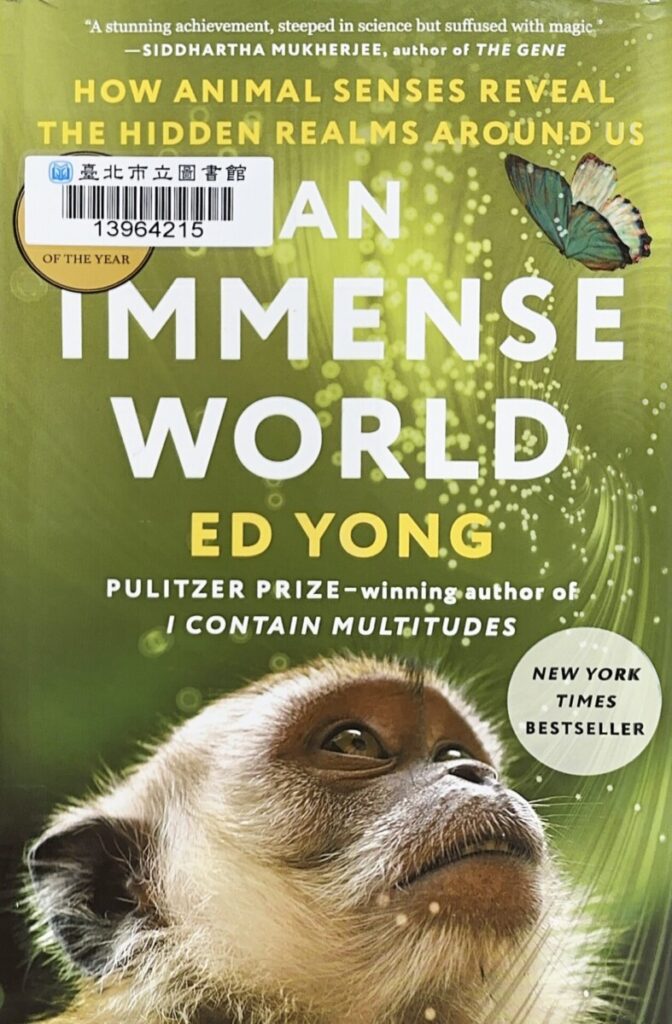
“An Immense World” 這本書強調,在觀察生物,了解它們的生態棲位的時候,要從生物它們的角度去看,避免把它們想像成我們自己。
為什麼呢?
譬如,人的眼睛只能看到可見光的範圍,用人看得見的部分來了解動植物,那麼動植物「看」得見但我們看不見的部分,就是一個很大的盲點。
紫外光就是一個淺顯的例子。
我總以為,花要開得鮮艷,味道要香或有特別的味道,或者花粉蜜要夠甜或營養,那麼才有助於授粉。
殊不知,有些花是會有紫外光的,我們人類看不到,但是對蜜蜂等昆蟲,那可是像點了一把熊熊的慾火呢!
摘錄一些書中關於視覺的重要的段落,跟大家分享。
我們人類的眼睛,只有三色視覺,現在出門看到鳥類、爬蟲類、昆蟲、淡水魚等等,要肅然起敬了。它們有四色視覺,硬是比我們多了一個顏色的維度,基本上也超出我們可以理解範圍,我們只能更加謙卑了。
—————————————————-
“There is a wonderful word for this sensory bubble Umwelt. It was defined and popularized by the Baltic-German zoologist Jakob von Uexküll in 1909. Umwelt comes from the German word for “environment,” but Uexküll didn’t use it simply to refer to an animal’s surroundings. Instead, an Umwelt is specifically the part of those surroundings that an animal can sense and experience its perceptual world. Like the occupants of our imaginary room, a multitude of creatures could be standing in the same physical space and have completely different Umwelt…”
「Umwelt」這個字在德文中意思是「環境」,是出生於波羅地海的德國動物學家Jakob von Uexküll所提出來的概念,特別指的是動物所能感知的環境。
“Uexkill compared an animal’s body to a house. “Each house has a number of windows,” he wrote, “which open onto a garden: a light window, a sound window, an olfactory window, a taste window, and a great number of tactile windows. Depending on the manner in which these windows are built, the garden changes as it is seen from the house. By no means does it appear as a section of a larger world. Rather, it is the only world that belongs to the house its [Umwelt]. The garden that appears to our eye is fundamentally different from that which presents itself to the inhabitants of the house.”
Uexkill把動物比喻為一棟有很多𥦬戶的房子,這棟房子面向一個花園。房子有各種窗戶:光線的窗戶、聲音的窗戶、氣味的窗戶、味道的窗戶、觸覺的窗戶。這些窗戶建造的方式,就會決定從房子裏往外看到花園的樣子。這個花園是不是大千世界的一部分並不重要,重要的是這個花園就是這棟房子所有的世界,這就是「Umwelt」的概念。
“Light comes in a range of wavelengths. Those we can see span from 400 nanometers, which we perceive as violet, to 700 nanometers, which we perceive as red. Our ability to detect these wavelengths, and the rainbow that lies between them, depends on our opsin proteins the foundation of all animal vision. Opsins come in different varieties, and each is best at absorbing a particular wavelength of light. Normal human color vision depends on three of these opsins, each of which is deployed by a different type of cone cell in our retinas. Based on their preferred wavelengths, the opsins (and the cones that contain them) are called long, medium, and short. More familiarly, they’re called red, green, and blue..”
光有各種不同的波長。可見光的波長介於400奈米(紫光)到700奈米(紅光)之間。我可以看到七彩的顏色,是因為視蛋白。不同的視蛋白會吸收不同波長的光線,讓我們看到不同的顏色。人類主要有三種視蛋白,分別在視網膜不同的錐狀細胞上。依照它們喜歡的波長,被稱為長、中、短,也就是紅光、綠光、藍光。
“But color vision involves more than merely detecting different wavelengths of light. It’s about comparing them. The signals from the three types of cones are added and subtracted by a complex network of neurons. Some of these neurons are excited by inputs from the red cones but inhibited by inputs from the green ones; they allow us to discriminate reds from greens. Other neurons are excited by the blue cones but inhibited by the red and green ones; they allow us to distinguish blues and yellows. This simple neural arithmetic -R – G and B – (R + G)-is called opponency. It’s how the raw signals from just three cones are transformed into the glorious rainbows that we perceive.”
從三種錐狀細胞產生的訊號,傳到神經系統中處理。有些神經元會被紅錐狀細胞傳來的訊息所激發,但會被從綠錐狀細胞傳來的訊號所抑制,所以就把紅色從綠色區別出來而看到紅色。有些神經元會被藍錐狀細胞刺激而被紅錐狀細胞、綠錐狀細胞抑制,那麼可以區別出藍色和黃色。以計算式表示就是 紅色-綠色;藍色-(紅色+綠色),這就叫做互補色。這也是為什麼雖然只有三種錐狀細胞,但卻可以讓我們看到七彩顏色的原因。
“Color, then, is fundamentally subjective. There’s nothing inherently “green” about a blade of grass, or the 550-nanometer light that it reflects. Our photoreceptors, neurons, and brains are what turn that physical property into the sensation of green. Color exists in the eye of the beholder- and also in their brain…”
顏色基本上是主觀的認定,並不是草葉的本質就有「綠色」,也不是說那是草葉反射岀來的光的波長是550奈米。而是我們的神經元和腦袋把光的物理性質轉化為「綠色」的感覺。顏色是觀察者眼睛看到什麼顏色,也是他腦袋中感受到的顏色。
“A small proportion of people, and entire species of animals, also see only in shades of gray, not because of brain damage but because their retinas aren’t set up for color vision. They are called monochromats…”
有少數人,看不到色彩,只看得到灰階。問題不在於腦袋,而是出在視網膜不具備轉換彩色訊號的相應錐狀細胞。他們是單色視覺者。
” Is that dark shape that just appeared the looming shadow of a predator, or merely the shadow of a sunbeam that briefly strayed behind a cloud? Monochromatic eyes that only deal in brightness and darkness would struggle to tell. But eyes that see in color would fare much better…That’s the basis of dichromacy, the simplest form of color vision. It’s what Retina, other dogs, and most mammals have.
Dogs have two cones one with a long, yellow-green opsin and another with a short, blue-violet one. They see mostly in shades of blue, yellow, and gray…”
對於單色視覺者而言,一塊黑影到底是掠食者還只是光線被遮蔽之後產生的陰影呢?如果能夠看出顏色,當然有助於分辨。這就是擁有雙色視覺的必要。
狗就是雙色視覺者。它們有長錐狀細胞的黃-綠視蛋白和短錐狀細胞的藍-紫視蛋白。
“…deuteranopes, who lack the medium green cones, come closest to seeing like dogs and horses. Their world is painted in yellows, blues, and grays, while reds and greens are hard to distinguish. Color-blind people might be confused by traffic lights, electrical wiring, or paint swatches. They might struggle to read packaging or charts, to distinguish sports teams that are wearing ostensibly distinct color, or to complete seemingly simple school assignments like drawing a rainbow…”
紅綠色盲者欠缺綠色錐狀細胞,他們的視覺接近狗和馬一樣,充滿黃、藍和灰色,他們無法分辨紅綠。色盲的人有困難分辨紅綠燈的燈號、電線配線和電子錶的顏色。外包裝、統計圖表、運動員衣著的特定顏色等等,都難以辨別,甚至在學校畫個彩虹的簡單作業都無法完成。
“It’s easy to assume that the dichromats must be at a disadvantage(compared to the trichromats.) But after 15 years of studying white-faced capuchins in the forests of Costa Rica, …Neither groups,…, is more likely to survive or reproduce than the other. The trichromats are indeed better at finding brightly colored fruit, but the dichromats surpass them at finding insects disguised as leaves and sticks. Without a riot of colors to confuse or distract them, they’re better at detecting borders and shapes, and seeing through camouflage….”
我們會很直覺認為擁有雙色視覺的相對於三色視覺的,在生存和繁衍後代上,將較為不利,其實不必然。科學家在哥斯大黎加森林研究巴拿馬白面卷尾猴十五年之後發現,其實他們各有千秋。三色視覺的巴拿馬白面卷尾猴,確實比較能夠找到鮮艷的果子,但是。雙色視覺的巴拿馬白面卷尾猴則能找到偽裝隱藏在葉子之間的昆蟲。
“In the 1880s, JOHN LUBBOCK-banker, archeologist, polymath-split a beam of light with a prism and shone the resulting rainbow onto ants. The ants scurried away from the light. But Lubbock noticed that they also fled from a region just beyond the rainbow’s violet end, which looked dark to his eyes. This area wasn’t dark to the ants, though. It was bathed in ultraviolet-literally “beyond violet” in Latin. Ultravio-let (or UV) light has wavelengths ranging from 10 to 400 nanometers.” It is largely invisible to humans, but must be “apparent to the ants as a distinct and separate colour (of which we can form no idea),”
在1880年代,John Lubbock 將穿過三稜透鏡產生的七彩光線拿去照射螞蟻,發現螞蟻不止避開了人類可見光的範圍,在紫色之外的某個區域它們也是避開的,這個區域就是後來依造”beyond violet”(紫色光之外)的拉丁字,取名稱之為”Ultraviolet”(紫外光) 。Ultraviolet”(紫外光) 的波長介於10-400奈米,人類的眼睛看不到,但是顯然螞蟻是看得到的。
“At the time, some scientists believed that animals either are colorblind or see the same spectrum that we do. Lubbock showed that ants are exceptional. Half a century later, bees and minnows turned out to see ultraviolet, too…,in the 1980s, researchers showed that many birds, reptiles, fish, and insects have UV-sensitive photoreceptors… In 1991, Gerald Jacobs and Jay Neitz showed that mice, rats, and gerbils have a short cone that is tuned to UV…In the 2010s, Glen Jeffery found that reindeer, dogs, cats, pigs, cows, ferrets, and many other mammals can detect UV with their short blue cones. They probably perceive UV as a deep shade of blue rather than a separate color, but they can sense it nonetheless. So can some humans…
This happened to the painter Claude Monet, who lost his left lens at the age of 82. He began seeing the UV light that reflects off water lilies, and started painting them as whitish blue instead of white.…Most animals that can see color can see UV. It’s the norm, and we are the weirdos.”
大部分的動物都看得到紫外光,但是大部分的人看不到。印象派大師莫內在82歲的時候,左眼會擋紫外光的水晶體損壞了,使得莫內看得見紫外光,所以他在畫水蓮的反光時,不是白色而是白色中帶有淡淡的藍。
“…Water scatters UV light, creating an ambient ultraviolet fog, against which fish can more easily see tiny UV-absorbing plankton. Rodents can easily see the dark silhouettes of birds against the UV-rich sky. Reindeer can quickly make out mosses and lichens, which reflect little UV, on a hillside blanketed by UV-reflective snow….“
紫外光在水中會散射,在周圍產生紫外光的薄霧,讓魚容易找到會吸收紫外光的浮游生物。紫外光讓鼠類更容易看到掠食性鳥類的身影,麋鹿更能迅速從反射紫外光的雪地裏找到苔蘚和地衣。
“Flowers use dramatic UV patterns to advertise their wares to pollinators. Sunflowers, marigolds, and black-eyed Susans all look uniformly colored to human eyes, but bees can see the UV patches at the bases of their petals, which form vivid bullseyes. Usually, these shapes are guides that indicate the position of nectar. Occasionally, they are traps. Crab spiders lurk on flowers to ambush pollinators.
To us, these spiders seem to match the colors of their chosen blooms, and they’ve long been treated as masters of camouflage. But they reflect so much UV that they are highly conspicuous to a bee, which makes the flowers they sit upon that much more alluring. Rather than blending in, some of them attract their UV-sensitive prey by standing out.”
花會用紫外光來吸引昆蟲授粉。向日葵、萬壽菊、黑心金光菊的等等的花色,在我們人類看起來都大同小異。其實,在花瓣的基部有花粉的位置,有個像牛眼般大的區域,會散發出紫外光。有些蟹蛛會躲在那附近以逸待勞,而蟹蛛本身就會散發紫外光,它們站出來,不只不會嚇走授粉的昆蟲,反而會讓那塊紫外光區域,變成是更致命的吸引力中心呢!
“It’s not just humans who can’t see UV patterns. Since UV light is heavily scattered by water, predatory fish that have to spot prey at a distance are often insensitive to it. Their prey, in turn, have exploited this weakness. The swordtail fish of Central American rivers look drab to us, but …, males of some species have strong UV stripes along their flanks and tails. These markings are alluring to females, but they’re invisible to the swordtails’ main predators…”
紫外光在水中散射,讓掠食性魚類很難從遠處就看清楚獵物。中美洲的劍尾魚在我們看起來外表長得單調無奇,但是它們有很多種類,在魚鰭和魚尾上是有紫外光的條紋的,對雌魚那是莫大的吸引力,但是掠食性的魚類卻是看不見的。
“…The reality is that UV vision and UV signals are extremely common.
“My personal view is that it’s just another color.”
能看到紫外光的視力,在生物界是非常普遍的。所以,我們只要把它單純當作是另外一種顏色就可以了。
“Tetrachromacy doesn’t just widen the visible spectrum at its margins. It unlocks an entirely new dimension of colors… dichromats can make out roughly 1 percent of the colors that trichromats see tens of thousands, compared to millions. If the same gulf exists between trichromats and tetrachromats, then we might be able to see just 1 percent of the hundreds of millions of colors that a bird can discriminate. “
四色視覺可以看到的顏色組合令人大開眼界。三色視覺可以看到百萬種顏色,而雙色視覺只可以見到三色視覺的1%種顏色,那麼就是1萬種。如果四色視覺和三色視覺可以看到顏色種類的差距也是那樣,那麼四色視覺就可以看到100萬種顏色了。
“Hummingbirds, with their four cones, can see a lot more of them, including UV-red, UV-green, UV-yellow (which is red + green + UV), and probably UV-purple (which is red + blue + UV). “
以蜂鳥為例,它是有鳥類的四色視覺的,有四個錐狀細胞,可以看到更多顏色,包括:UV-red, UV-green, UV-yellow ( = red + green + UV),也可能可以看到UV-purple ( = red + blue + UV).
“Birds aren’t the only tetrachromats. Reptiles, insects, and freshwater fish, including the humble goldfish, have four cones as well. By looking at tetrachromats among modern animals and working backward, scientists can deduce that the first vertebrates were likely tetrachromats, too. Mammals, probably because they were all initially nocturnal, lost two of their ancestral cones and became dichromats…”
除了鳥類之外,爬蟲類、昆蟲、淡水魚(包含普通的金魚)都是四色視覺所動物。由此往前推,顯然最早的脊椎動物應該是四色視覺的。而至於有些哺乳動物,由於屬於夜行性的動物,自然而然之後失去了兩組錐狀細胞,而變成了雙色視覺的動物。
“It’s ironic that for the longest time, illustrators and filmmakers portrayed dinosaurs in dull shades of brown, gray, and green. Only recently have artists started painting these animals with bright colors, inspired by the revelation that they are the ancestors of birds. But even these vivid hues, applied with a trichro-mat’s eye, capture just a tiny proportion of the colors that dinosaurs probably wore or saw…”
很諷刺的是,電影經常把恐龍畫成黃、灰、綠等單調的顏色,後來可能突然福至心靈想到恐龍是鳥類的祖先,才開始畫上鮮艷的色彩。但是,那些鮮艷的色調,也只是三色視覺,是四色視覺的恐龍可以看到的顏色種類之中,極少極少的一部分。
But there is no way to representing a tetrachromat’s color vision for a trichromat’s eye.
用三色視覺可以看到的顏色,來描四色視覺可以看到的顏色,是不可能的任務。
“Most butterflies are trichromats. Like bees, they have three opsins that are most sensitive to UV, blue, and green, and can see colors ranging from red to UV. But in 2010, Briscoe discovered that Heliconius butterflies differ from their relatives …they’re tetrachromats…In 2016, Briscoe’s student Kyle McCulloch found that only female eratos are tetrachromats. The males are trichromats…”
大部分的蝴蝶,都是三色視覺。後來發現在䄂蝶屬,有些蝴蝶是四色視覺的,而且很奇特的是,只出現在雌性的蝴蝶,雄性的都是三色視覺。
“These butterflies are not the only species with a sex difference in tetrachromacy. Humans share that trait. Somewhere in Newcastle, England, lives a woman known in the scientific literature as cD229…
according to psychologist Gabriele Jordan, who has worked with her extensively, cD229 aces tests that only a tetrachromat could pass. Much like Stoddard’s hummingbirds, she can pick out one shade of green among other extremely similar ones, “like a cherry from a tree,”
和蝴蝶一樣,在人類也只有女性有四色視覺(但人數極少)。在英國有位編號為cD229的女士,能在瞬間輕易從差異極細微的綠色中辨識出不同的顏色出來,而那是只有擁有四色視覺者才辦得到的。
“Primates, for example, evolved trichromacy to better spot young leaves and ripe fruits. And once they added red to their Umwelt, they began evolving patches of bare skin that could convey messages by flushing with blood. The red faces of rhesus macaques, the red rumps of mandrills, and the comically red and bald heads of uakaris are all sexual signals made possible by trichromatic vision.”
靈長類發展出三色視覺的能力,以便易於找到(紅色)的嫩葉(富含蛋白質)及成熟的果子。一旦在Umwelt中加入了紅色,身體就演化出一片沒有毛的皮膚,可以充血來傳達訊息。恆河猴的紅臉,彩面狒狒的紅屁股,白禿猴的紅臉和禿頭,都是有了三色視覺之後,才可能展現出性吸引力訊號。
“Most of the fish in coral reefs are also trichromats. But since red light is strongly absorbed by water, their sensitivities are shifted toward the blue end of the spectrum. This explains why so many reef fish, like the blue tang that stars in Pixar’s Finding Dory, are blue and yellow.
To their version of trichromacy, yellow disappears against corals, and blue blends in with the water. Their colors look incredibly conspicuous to snorkeling humans, because our particular trio of cones excels at discriminating blues and yellows. But the fish themselves are beautifully camouflaged to each other, and to their predators.”
大部分珊瑚礁魚,也是三色視覺。因為水會吸收紅色光,珊瑚礁魚比較敏感的顏色,是比較偏藍色光的,這解釋了為什麼它的顏色是黃和藍。在珊瑚礁魚的三色視覺看起來,黃色自然混在珊瑚礁中而不明顯,藍色和水色自然混在一起。珊瑚礁魚的顏色,對浮潛的我們看來很醒目,因為我們人類的三色視覺很善於分辨黃色和藍色。但是對於魚類來說,那是很好的偽裝色,掠食者也不容易找到它們。
“You can apply the same logic to flowers. In 1992, Lars Chittka and Randolf Menzel analyzed 180 flowers and worked out what kind of eye would be best at discriminating their colors. The answer- an eye with green, blue, and UV trichromacy- is exactly what bees and many other insects have. You might think that these pollinators evolved eyes that see flowers well, but that’s not what happened. Their style of trichromacy evolved hundreds of millions of years before the first flowers appeared, so the latter must have evolved to suit the former. Flowers evolved colors that ideally tickle insect eyes.”
科學家研究過,能夠分辨綠色、藍色、紫外光的眼睛的昆蟲,對花朶的授粉最有利。而其實,開花植物是在昆蟲存在數億年之後才出現的,所以正確的說法應該是,開花植物演化出了綠色、藍色、紫外光的組合,來適應昆蟲三色視覺看來最顯目顏色的能力。
“I find these connections profound, in a way that makes me think differently about the act of sensing itself. Sensing can feel passive, as if eyes and other sense organs were intake valves through which animals absorb and receive the stimuli around them. But over time, the simple act of seeing recolors the world. Guided by evolution, eyes are living paintbrushes. Flowers, frogs, fish, feathers, and fruit all show that sight affects what is seen, and that much of what we find beautiful in nature has been shaped by the vision of our fellow animals.
Beauty is not only in the eye of the beholder. It arises because of that eye.”
當我們講到「感覺」,有像有點被動,動物的眼睛或它們其他的感覺器官,好像只是接受外界刺激的開關。但是,時間一旦拉長了,動物單純觀看的這個舉動,就能改變這個世界的顏色。在演化的推波助瀾之下,眼睛就像上色的刷子一樣。開花植物、蛙類、魚類、鳥類(的羽毛)、果實(的熟度),都是視力最終影響到動植物看起來的樣子的例子,這也說明了,美麗的大自然,原來是動物的視力所塑造出來的。
換句話說,大自然的美麗,不只是情人眼裏出西施;大自然的美麗、也是女為悅己者容。
*:ED Yong, “An Immense World,” 2022, Random House/New York
2023/8/31 An Immense World Damakey
