
‘Are alien plants bad? The preponderance of evidence says yes. Compared to native plant communities, introduced plants are bad at supporting insects and are thus bad at supporting insectivores. They are bad at supporting specialist pollinators, complex food webs, stable food webs, local biodiversity, interaction diversity, and, most important of all, they are bad at supporting ecosystem function. I recognize there are social constraints on what we can do with this information, but we should no longer accept the notion that introduced plants are the ecological equivalents of the native plants they replace.’*
Take kudzu as an example.
‘When kudzu smother young oak trees in Camden County, Georgia, for example, a host option for 454 species of caterpillars disappears under mounds of kudzu leaves. Similarly, if black berry is eliminated from this kudzu patch, 324 caterpillar species are lost. If willows, hickories, and maples are covered by kudzu, 247, 229, and 223 species of caterpillars are lost, respectively… if kudzu smothers goldenrod, as it surely would, 94 species of caterpillars are lost. If it covers native asters, another 80 species are lost. Sunflowers lost to kudzu host 67 species of caterpillars, horsenettle 67 more species, and so on. By allowing kudzu to invade an area in Camden County, Georgia, we have gained a host plant for silver-spotted skipper, but we’ve lost host opportunities for the caterpillars of more than 1000 other moths and butterflies. And, as with all food web, impacting all of species that eat he caterpillars lost to kudzu…’*
The above is an example of simple cost and benefit calculation on an introduced plant, kudzu.
Another example is phragmites australis.
‘In Europe, phragmites supports 170 species of insects. After hundreds of years of residence in North America, only 5 insect species are using phragmites as a nutritional resource…Adaption is happening, but at a glacial rate typical of evolutionary change…’
The insight of phragmites introduced to America is that even the alien plant looks having adapted to local environment and growing well, it doesn’t mean its impact to local ecosystem has been neutralized, rather it always had been done and caused harm much more than we can imagine.
What we can do in our backyard to make it more eco friendly?
1. Restore plants: choose to plant native species, including weeds; remove invasive species; plant keystone genera which are friendly to local ecosystem; plant for special pollinators; plant for diversity.
2. Restore insects:don’t spray insecticides and herbicides; don’t fertilize; create caterpillar population sites under your trees.
3. Restore native bees.
‘From the return of life to the volcanic ruins of Krakatoa,…to the rewilding of the area surrounding the Chernobyl nuclear meltdown in the Soviet Union,…to the transformation of Ohio’s Guyahoga River from industrial sludge and fire to our most recent national park, we have witnessed time and again how quickly and completely nature can restore herself from utter destruction. Nature’s inherent resiliency is the primary source of my motivation to change the landscaping paradigm from one that excludes the nature world to one that embraces it…’*
To contribute to eco system, we can start from our back yard and the small garden. Plant native plants and create friendly environment for local insects, especially local bees.
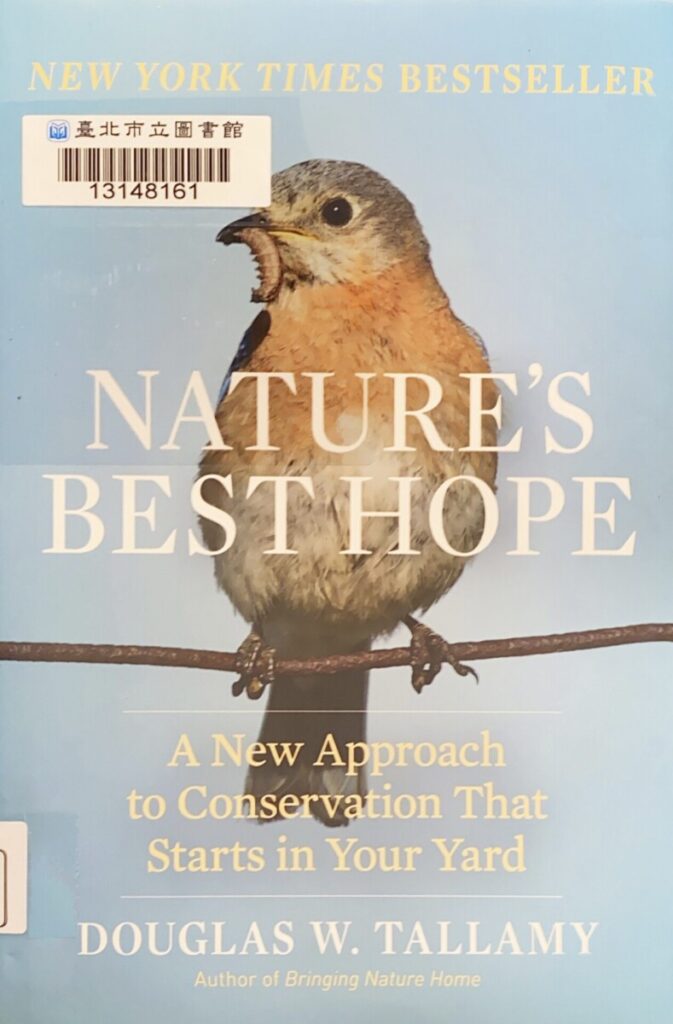
*: Douglas W. Tallamy, 2019. Nature’s best hope. Timber Press, Inc.
2023/3/24 Nature’s best hope Damakey
