
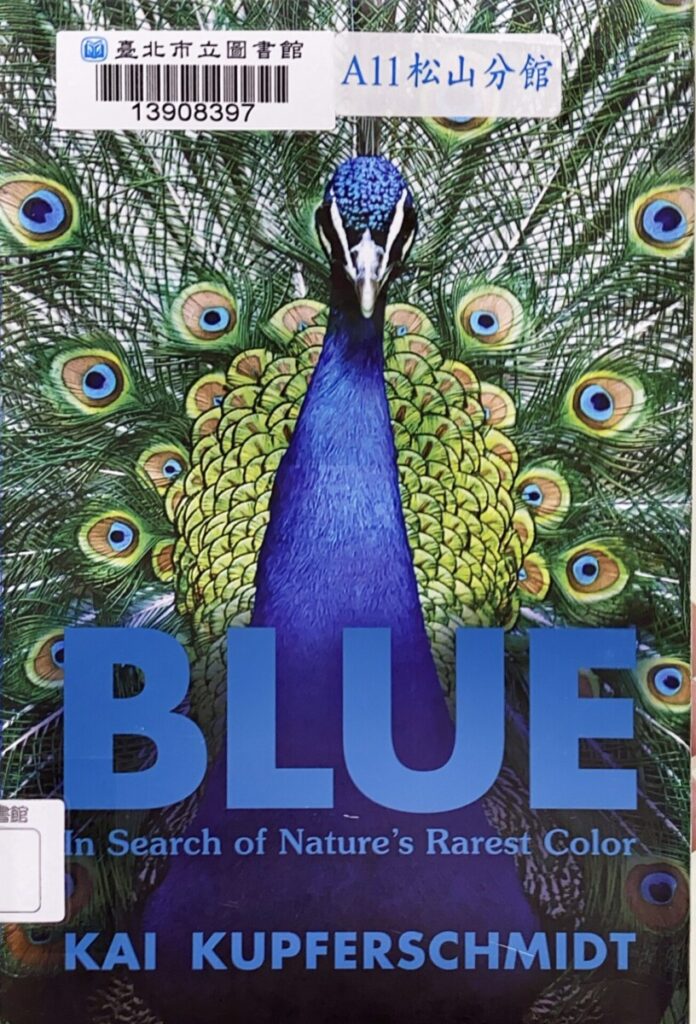
Why the sky is blue; why the plant leaves are green; why we depends on plants for being able to see; and why blue flowers are so rare?
‘…Shortwave and long-wave X-ray and long-wave radio waves are largely reflected back into outer space. Infrared red radiation doesn’t get through the atmosphere either. It is absorbed by the gas molecules of the air.
But radiation with a wavelength of around 430 to 690 nanometers, the range that humans perceive as white light, manages to pass through the atmosphere almost unfiltered. Scientists call this the “optical window.” It is the window we see the world.
However, the light in the range does not reach Earth’s surface all at once—nitrogen and oxygen molecules diffract the short waive blue and violet light to a greater extent, so that the rays that leave the Sun as white light reach us with some of their blue portion missing. That’s why the sun looks yellow. And the sky is blue for us because that diffracted blue light is scattered across the sky and reach us from all direction…
To be precise, only a small portion of the blue light is scattered across the sky. And the light that is most readily dispersed has wavelengths that are even shorter than violet light. This light falls in the ultraviolet range. So we are surrounded by UV light, which is why you get a sunburn even in the shade.’
When the light reach the surface of earth, it has a full spectrum of visible light, red, yellow, green, blue, purple, etc. The color we see is the color reflected. Leaves are green because lower energy and longer wavelength Red light is absorbed and higher energy and shorter wavelength Green light is reflected to reach our eyes. So we see leaves green.
500 million years ago: vertebrates have 4 types of cones of vision, including red, green, blue and, ultraviolet.
200 million year ago: mammals under the evolution pressure imposed by the dinosaurs, were only active in the night time and lost two types of the four light receptors(cones of vision). Only green and ultraviolet cones were kept. But their sensitivity had been changed and been transforming to the present-day blue cone.
30 million year ago: some mammals acquired a third cone of vision again, green cone. Due to some genetic duplication error by green cone, a red cone appeared. Hence human had green, red and blue cone since.
‘…We depend on plants to be able to see at all. Human cannot produce retinal themselves; for that we have to ingest the plant pigments beta- and alpha-carotene, the precursors of vitamin A that are converted into the vision pigment retinal, mostly via cells in the intestines. The vision animals needs plant to see…’
Leaves looks green meaning they do not use green light for photosynthesis. It seems kinds of waste. But why? There is no conclusive explanations so far.
‘…In autumn the trees reduce the amount of chlorophyll in their leaves and at the same time start to produce anthocyanin. This may protect the leaves from damage caused by strong sun light. The leaves will soon fall off anyway, but before that happens the tree tried to extract as much resources as it can from them to store over the winter…’
‘…Plants need the energy of light to live, and when they absorb certain wavelengths, the remainder, which they reflect, appears colors. But why is the reminder so rarely blue?
One explanation comes from the chemistry of plant pigments. It appears to be extremely difficulty for nature to produce a molecule that absorbs red (yellow?) light, which is what would be needed to appear blue. Neither chlorophylls or betalains nor carotenoids occur in blue flowers. In fact, among all the pigments in the plant kingdom, there is only one group that is capable of coloring a blossom blue: the anthocyanins…’
Anthocyanin = anthos(blossom)+ cyanos(blue) : 花青(素)
We see beautiful colors via life and death.
‘To see beauty is also to see the death it bears within itself…The radiant blue of the morpho butterfly is the result of a seemly endless series of predecessors in which every generation has make way for a new, bluer, more beautiful generation. Life and death, life and death, life and death: That is the rhythm to which evolution plays its time.’
The sky blue is diffracted missing light. The green color of leaves is the light abandoned by the busy plants. We see what is reflected and then believe the opposite side of the truth. That’s all the nature tells.
*: Kai Kupferschmidt, ‘Blue, in search of Nature’s rarest color,’ 2021, The Experiment, N.Y.
2023/4/21 Blue, in search of Nature’s rarest color Damakey
