
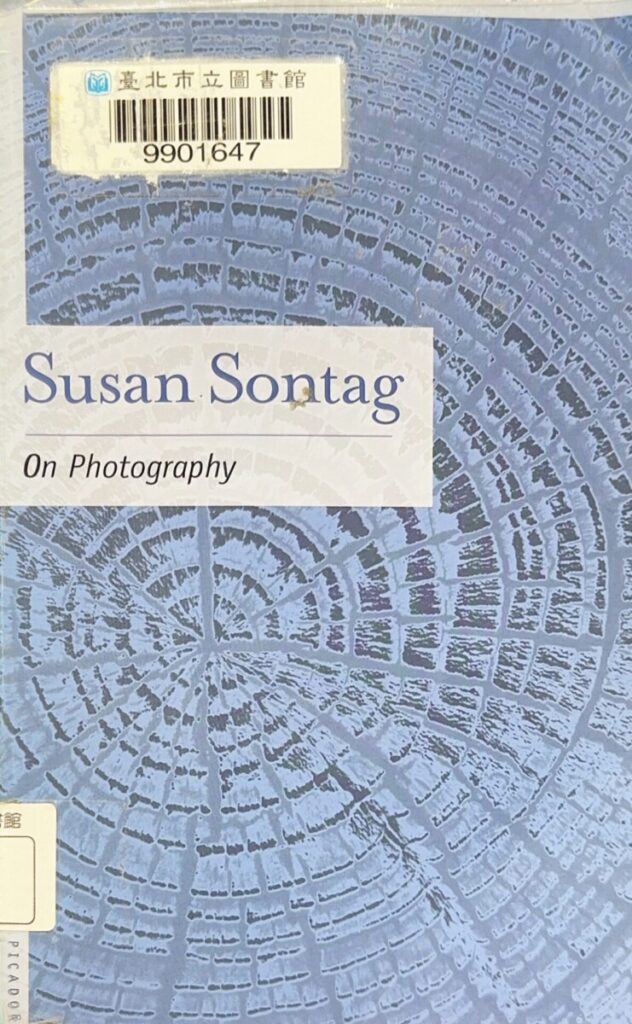
桑塔格(Susan Sontag,1933-2004)所寫的《On Photography》,咸認為是關於攝影理論非常經典的著作。
當博物館開始典藏攝影作品,攝影作品像繪畫一樣,也被視為藝術品,似乎已經是蓋棺定論的事了。
但是,在桑塔格出版《On photography》的1970年代,撮影是否是一種藝術,則還是存在著爭論的:
Those still involved in defining photography as an art are always trying to hold some line. But it is impossible to hold the line: any attempt to restrict photography to certain subjects or certain techniques, however fruitful these have proved to be, is bound to be challenged and to collapse. For it is in the very nature of photography that it be a promiscuous form of seeing, and, in talented hands, an infallible medium of creation. (As John Szarkowski observes, “a skillful photographer can photograph anything well.”) Hence, its longstanding quarrel with art, which (until recently) meant the results of a discriminating or purified way of seeing, and a medium of creation governed by standards that make genuine achievement a rarity. Understandably, photographers have been reluctant to give up the attempt to define more narrowly what good photography is. The history of photography is punctuated by a series of dualistic contro-versies— such as the straight print versus the doctored print, pictorial photography versus documentary photography— each of which is a different form of the debate about photography’s relation to art: how close it can get while still retaining its claim to unlimited visual acquisition. Recently, it has become common to maintain that all these controversies are now outmoded, which suggests that the debate has been settled. But it is unlikely that the defense of photography as art will ever completely subside. As long as photography is not only a voracious way of seeing but one which needs to claim that it is a special, distinctive way, photographers will continue to take shelter (if only covertly) in the defiled but still prestigious precincts of art.
中譯:
那些還一直努力於定義攝影是一種藝術的人,他們總是試圖在某些看法上讓自己能夠站得住腳。但是,他們不可能永遠都站得住腳:任何試圖把攝影限制在特定的主題或技術的努力,不管成果如何,終將遭致挑戰而分崩離析。因為就攝影的本質而言,是很隨性的觀看方式,而在有天賦的行家手𥚃,則是永不失敗的創作媒體。(正如John Szarkowski 所觀察到的,「技巧高超的攝影師可以把任何東西都拍好」) 。因此,長期爭論攝影是否是藝術,( 一直持續到最近)代表透過不同的或單純的觀看方式完成的攝影作品,是由各種標準所形塑的創作媒體,很難能夠達到作品原創無偽的要求。攝影師一直不願意放棄把什麼是好攝影定義得更明確的意圖,這是可以理解的。攝影的歷史,就是斷斷續續由一系列的對立爭議所組成的,諸如原圖印刷或修圖印刷、畫境攝影或紀實攝影等等,每一種爭論都聚焦於攝影和藝術的關係:攝影如何更接近藝術,但依舊能夠保持它無限制攝取影像的能力。最近,咸認為這些爭論已經過時,也就是說爭議已經塵埃落定。但是,似乎主張攝影是一種藝術的保衞戰,並未完全消停。只要攝影既是一種貪婪的觀看方式,又是必須強調它是特別的、獨特的觀看方式,那麼攝影師將繼續(或許偷偷地)庇蔭於被玷污但依舊至高尊貴的藝術殿堂𥚃。
……
桑塔格在書中,特別指出為什麼繪畫會是藝術。
繪畫必須有高超的技巧。所以繪畫的藝術價值,和是誰畫的很大的關係。從畫家個人特別的筆觸、色調和構圖,可以辨別出真偽。而畫家所屬派系的畫風,也讓繪畫本身的辨識度變高。
但是,攝影卻頗為不同。隨著科技的進步,除了專業的攝影師,業餘的人,也可以拍出非常好的作品。而且什麼都可以拍,也都可能拍得不錯。
物以稀為貴。不管攝影是不是一種藝術,光以攝影對各種主題的各種觀看方式所拍的作品,其差異之大數量之多,至少在「價格」上面就不可能穩定。
博物館收藏的攝影作品的價值,桑塔格已經點出了重點,那是因為被收藏了,才變得有價值的。
攝影是雅俗共賞,換句話說,每張照片都有它可以被欣賞的地方,會有人喜歡,縱使是其他大部分的人不喜歡,也沒有關係。攝影被作為藝術,有一個很大的問題是在這方面嚴肅的評論太少。除了看構圖、景深曝光、主題等等之外,還有什麼?漂亮?一張攝影作品的好壞,往往淪為各說各話或人云亦云的狀況。
尼采說,感到某個東西漂亮,那麼一定是錯誤的體驗方式所致。(To experience thing as beautiful means: to experience it necessarily wrongly. ~ Nietzche)
呃……尼采大師是說錯得漂亮?
繪畫則很不同,由畫家、畫派、收藏家、畫評等等所累積的,所謂的藝術的評價,是有深厚的基礎的。
桑塔格提到,確實有攝影師,用特定的觀察主題和方式來攝影,而顯得獨樹一格。
她提到了諸多攝影師中,我對Diane Arbus(1923-1971)印象最為深刻。
根據維基百科:
She photographed a wide range of subjects including strippers, carnival performers, nudists, people with dwarfism, children, mothers, couples, elderly people, and middle-class families. She photographed her subjects in familiar settings: their homes, on the street, in the workplace, in the park.
Diane Arbus一反遠遠拍攝主題的做法,她反而往往親切地和她想拍的對象攀談,然後近距離在適當的時機按下快門。她拍了很多在當時社會上比較不被注意的群體,尤其是那些處在社會邊緣的人,對象遍及脫衣舞者、嘉年華會表演者、裸體者、侏儒、兒童、母親、夫妻、老人、中產家庭等等。
Diane Arbus是這樣說明她的攝影取向的:
If I were just curious, it would be very hard to say to someone, “I want to come to your house and have you talk to me and tell me the story of your life.” I mean people are going to say, “You’re crazy.” Plus they’re going to keep mighty guarded. But the camera is a kind of license. A lot of people, they want to be paid that much attention and that’s a reasonable kind of attention to be paid. —Diane Arbus
中譯:如果我只是基於好奇,要我這樣告訴我想攝影的對象是很難說得出口的:「我想去你家拜訪你,聽聽你告訴我你的人生故事。」 我的意思是說,如果是那樣,人們的反應會是:「你瘋了嗎?」 而且他們將展現出很強的自我防衛。 但是,相機是我用來親近人的一種專利(利器)。有很多人,他們希望受更多的矚目,那就是我可以特別關注並為他們攝影的原因。(~ Diane Arbus)
“Photography was a license to go wherever I wanted and to do what I wanted to do” (~Diane Arbus) 。所以Diane Arbus會說:「攝影是我的一項利器,我可以去任何我想去的地方,去做我想做的事(攝影)」
據說有些Diane Arbus的攝影作品,不見容於當時的道德標準,在每天攝影展結束的時候,工作人員都要費心去擦掉不滿的觀眾吐在攝影作品上面的唾液呢!
”A photograph is a secret about a secret.” 一張攝影是一個關於密秘的密秘。(~ Diane Arbus)
Diane Arbus在1971年抑鬱自殺身亡。是不是因為她長年攝影比較不堪入目的對象以致身心受創,不得而知,然而,她的自殺身亡,則更突顯了她的作品對社會中比較不被注意群體的關心。
像Diane Arbus這樣,在那個攝影正當開始勃興的時候,透過關注特定的題材而顯得很有特色,是提高攝影師的鑑別度的方法,從攝影作品來分辨出是哪一位攝影師的作品。
但是,如果是現在,就很難了。擅長拍攝風景、貧民窟、街景、人物等等特定主題的攝影師,如過江之鯽,相信很難從一張照片看出是哪位大師拍的吧!甚至,很多被視為大師級的作品,是來自於業餘的攝影師呢!如果又再加上Photoshop等後製工具和自動擬真成像的AI技術,那麼就又更難了。
《On Photigraghy》 首度出版於1973年,那是Internet發展非常初期的階段,及至大家開始使用網路大量交換資訊(和影像),那麼Facebook 成立的2004年就是一個標誌性的年度,很不幸桑塔格在那同一年去逝了。然而1970年代桑塔格在《On Photigraghy》 談的攝影理論,在今日看來,依舊經典。
回到《On Photigraghy》的開篇,桑塔格把攝影比喻為對被攝者的冒犯,攝影看到被攝者自己看不到的自己。攝影機有若槍枝的昇華,攝影是一種溫柔的謀殺:
…To photograph people is to violate them, by seeing them as they never see themselves, by having knowledge of them they can never have; it turns people into objects that can be symbolically possessed. Just as the camera is a sublimation of the gun, to photograph someone is a sublimated murder——a soft murder, appropriate to a sad, frightened time.
攝影蒐集的是過去,而繪畫則是面向的是愈陳愈有價值的未來。看到攝影作品,尤其是像FB等社交媒體跳出來幾年前的身影,會令人蒙上一些感傷,因為那代表的是對過去,那些已經消逝死亡的光陰的哀悼。我記得桑塔格是如是說的。
Photography implies that we know about the world if we accept it as the camera records it. But this is the opposite of understanding, which starts from not accepting the world as it looks. All possibility of understanding is rooted in the ability to say no. Strictly speaking, one never understands anything from a photograph.
大意:我們看到攝影作品,往往以為它們忠實反應了這個世界的真實,而這和我們真正的人生體驗,則是恰恰相反的。我們對這個世界的認知,不是建立在於我們看到它們是什麼,而是建立在我們看到它們不是什麼之上的。桑塔格也是如是說的。
桑塔格也提到攝影是透過影響我們的想像,如何塑造我們對世界的看法。近年來在社交媒的假消息的充斥,三人成虎。而相同意見的人在網路上頻頻相互取暖,形成所謂的同溫層,原來那是攝影可以造成的影響。桑塔格在沒有Internet 之前就預見了攝影對人們認知的影響。
所以,什麼是經典?不就是像藝術一樣,不只抵過時間的考驗,還會因爲時間過去而愈陳愈香呢!
柏拉圖對於無知的原始人類,有一個「洞穴陰影」的比喻,原始人有若困坐在黑漆的洞中,只見到外面真實世界映照在石壁上的陰影,就以為那是真實。
桑塔格則認為,攝影的力量,可以反轉柏拉圖的「洞穴陰影」思考。攝影就有若那洞中石壁的影子,但攝影它們本身就是實際的存在,比影子還富含資訊,可以扭轉我們對現實的理解:
The powers of photography have in effect de-Platonized our understanding of reality, making it less and less plausible to reflect upon our experience according to the distinction between images and things, between copies and originals. It suited Plato’s derogatory attitude toward images to liken them to shadows-transitory, minimally informative, immaterial, impotent co-presences of the real things which cast them. But the force of photographic images comes from their being material realities in their own right, richly informative deposits left in the wake of whatever emitted them, potent means for turning the tables on reality-for turning it into a shadow. Images are more real than anyone could have supposed. And just because they are an unlimited resource, one that cannot be exhausted by consumerist waste, there is all the more reason to apply the conservationist remedy. If there can be a better way for the real world to include the one of images, it will require an ecology not only of real things but of images as well…
桑塔格在1970年代觀察到,當時旅客習於用相機攝影留念,但是反客為主,旅遊反而變成以攝影為主,而忘了當下要享受的體驗了。放在2024年的現在來看,這個現象更加重了,人們不止忙著攝影,還忙著上傳到社交媒體中分享呢:
A way of certifying experience, taking photographs is also a way of refusing it—by limiting experience to a search for the photogenic, by converting experience into an image, a souvenir…
不過,桑塔格也說,”To photograph is to confer importance”,「攝影之以示其重要性」。所以呀,就對自己覺得重要的,繼續拍、拍、拍…….
*:Susan Sontag, 《On Photography》,1990,Farrah, Straus and Giroux
2024/7/9 On Photography Damakey
