
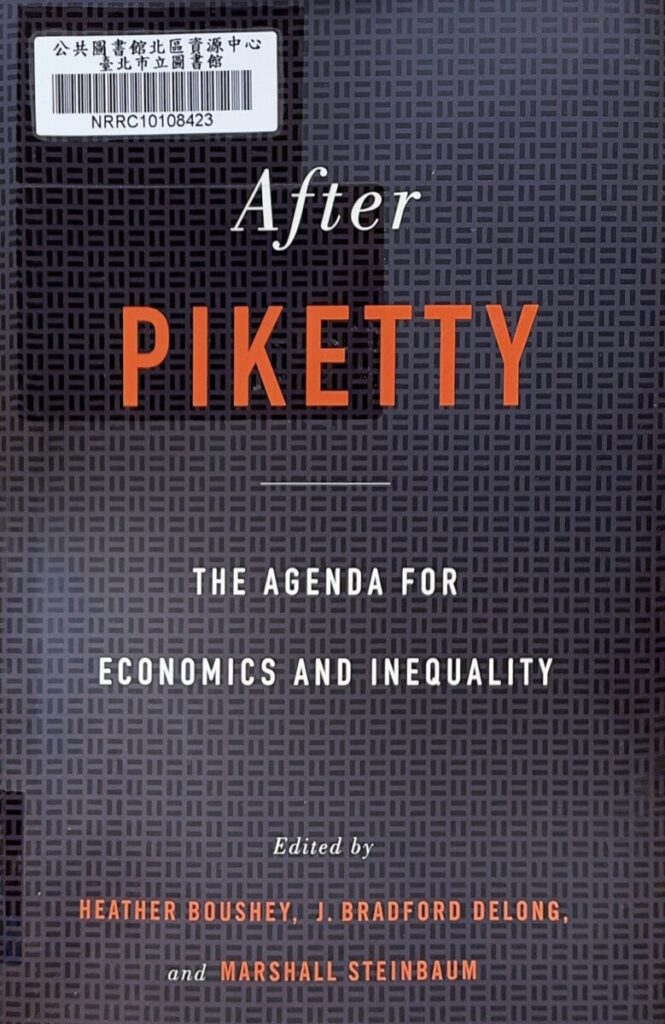
《After Piketty》這本書是對Piketty所寫的那本《Capital in he Twenty-First Century 21世紀資本論》的一個回應。
在《After Piketty》這本書中,是這麼言簡意賅地說明了《21世紀資本論》主要的論述:
Piketty’s world is particularly grim because it’s predetermined. So long as the rate of profit is above the rate of growth, we’re destined to move toward ever-increasing inequality. The only thing we can do is figure out how to tally up the massive wealth and tax it—if we can overcome the ability of wealth to protect itself by constraining political options.
Piketty的世界是特別悲慘因為他認為註定會發生。只要利潤率(r)高於成長率(g),那麼不斷增大的貧富差距,就是我們的未來要面對的命運。我們唯一可以做的是,去想辦法計算出有錢人擁有的巨大財富金額,然後課(財富)稅——如果我們可以反制有錢人的反撲,不因此限制了我們可以採取的各種可能的政治手段。
In Capital in the Twenty-First Century, Piketty employs a growth model to explain how a falling rate of economic growth would affect the capital share. Under his model, a lower growth rate would increase the capital / output ratio; this rise in the capital / output ratio would also increase the capital share if the capital-labor substitution elasticity is above one. Piketty then estimates this elasticity to be substantially above one by using the historical co-movement of the capital / output ratio and capital share.
在《21世紀資本論》中,Piketty運用了一個成長模型來解釋,經濟成長率的降低是如何影響到資本生產要素的占比。就這個模型而言,一個成長率的降低將會增加資本/產出這個比率;資本/產出這個比率的增加,只要資本和勞動力的替代彈性是大於1,也會增加資本生產要素的占比。Piketty用資本/產出和資本生產要素占比連動的歷史資料,估算出(資本和勞動力的)替代彈性,是遠遠大於1的。
…..
在《After Piketty》這本書對Piketty 《21世紀資本論》這本書最致命的批評,是Piketty主張資本和勞動力的替代彈性是遠遠大於1的估算。
不管是從總體經濟或個體經濟的角度,由學者諸多文獻的回顧看來,資本和勞動力的替代彈性是小於1的。
《After Piketty》這本書認為Piketty 把勞動這項生產要素佔比的減少(相對就是資本這項生產要素佔比的增加)歸因於資本和勞動力的替代彈性大於1,是錯誤的。該書認為全球化(Globalization)和促進生產力的科技進步(labor-saving technology progress)才更是更合理的解釋。
針對《21世紀資本論》最後主張要對有錢人課征財富稅,《After Piketty》這本書認為那是完全不可行的。
《After Piketty》這本書最後一章舉美國為例,說明連美國要課財富稅都很困難,更何況世界各國的國情都不同,而跨國企業往往也把公司登記到稅率較低或免稅的國家來節稅,那麼怎麼在全世界各地區一起向富人課財富稅呢?
美國的稅制是國會決定的,而國會議員代表是人民選出來的。(在美國,每個人都有投票權,是晚近才發生的事。1965年開始,美國的黑人才有投票權。)
縱使國會議員代表是人民選出來的,但是很多研究顯示,人民的票並不是票票等值的。富有的人對政策的影響是較大的。
美國政府的政策,受到遊說團體的左右。那麼又是誰影響著遊說團體呢?大公司和各種利益團體等等,而在它們的背後,就是財力雄厚的有錢人。有實證研究顯示,有錢人的政治聲量顯然較大,而經濟能力屬於中下階層的聲音,則比較是被忽略的。
美國國會所制定的稅法,代表各界利益角力,也就像拼製車一樣充滿漏洞,而基本上是對有錢人是比較友善、比較有利的。
國會議員代表有錢人的利益,誰會把大刀向著自己(以及他們的恩主)呢?他們競選連任的時候,還需要金本(恩主) 的大力贊助呢!
所以《21世紀資本論》主張要對有錢人課征財富稅,在美國就基本上就是不可能的。
在美國貧富差距之大,往往人民之間分成好多不同的階級,連居住的區位也不同。貧富分區的問題,造成位處於比較不富有地區的地方政府,財政往往較為緊絀,以致於公共學校、馬路公園、公共交通等等公共財的供應不足或年久失修,而這也會進一步拉大貧富的差距。
……
美國最富有的那群人對貧富不均的看法又是什麼呢?:
Perhaps most notable in the context of Piketty’s work are the attitudes of the wealthy toward economic inequality and their preferences for what ought to be done (and not done) about it. Fully 86 percent of wealthy Americans are aware of the fact that income and wealth have grown more concentrated. And half (56 percent) did not accept the proposition that “large differences in income are necessary for Americas prosperity.” About two-thirds (62 percent) said that differences in income are too large. While wealthy Americans believe that pay for hedge fund managers and CEOs of large corporations should be reduced, and that pay for low-wage occupations should be increased, they emphatically (87 percent) do not view it as the role of government to “reduce the differences between those with high incomes and those with low incomes.” 83 percent said that the government should not redistribute wealth by heavy taxes on the rich. In contrast, 46 percent of the general public say that reducing income differences should be the role of the government, and 52 percent say the government should accomplish as much by heavy taxes on the rich. In short, the wealthy aren’t going to go for Piketty’s global wealth tax, or even for a more modest domestic version.
或許Piketty 書中最值得注意的是美國的富人對美國貧富不均的看法,以及他們認為應該做的是什麽而不該做的又是什麼。
86% 的富人意識到財富變得更集中了。
56% 的富人不認為收入的巨大差異是美國繁榮的必然結果。
62% 的富人認為收入的差異太大。
87% 的富人雖然認為付給避險基金經理人和大企業執行長的薪水應該降低,低薪工作的薪水應該增加,但他們不斷強調,不認為減少收入的差異是政府應該扮演的角色。
83% 的富人認為政府不應對富人課以重稅來重新分配財富。
46%的大眾認為減少收入的差距應該是政府應該扮演的角色。
52%的大眾認為政府應該儘可能向富人課以重稅。
簡而言之,富人根本不認同Piketty全球財富課稅的想,甚至一個更小規模的國內做法也不贊同。
《After Piketty》這本書也探討了貧富不均對總體經濟的影響。基本的結論是貧富不均會減緩經濟成長,但是影響不算太大。在經濟上行的時候比較沒有關係,但是一旦經濟反轉往下,景氣進入衰退,貧富不均的社會則會面對較大的風險:
…Greater inequality likely makes the financial system less stable, as credit-constrained low-income households are potentially significant risks, and the economy more cyclical, as wealthier households that account for the bulk of the spending are sensitive to swings in increasingly volatile asset markets. This may not be a big deal if financial markets and the economy move in a more or less straight line, but it could be a huge deal if they don’t.
貧富愈不均,金融系統愈不穩定,信用有限的低收入戶,非常可能面臨極大的風險,而且經濟景氣循環上下的變化更頻繁,因為消費主力的較富裕家庭對資產市場的巨大變動是很敏感的。這在經濟持平的時候或許對金融市沒有什麼影響,但是如果不是,那麼影響就會非常巨大。
This is especially true given that the economy’s potential growth will be much slower going forward than in the past, suggesting that recessions will be more likely. With monetary and fiscal policy almost certainly rendered more impotent by the zero lower bound and tighter political fetters, future recessions could be more severe.
如果經濟成長會比以前還緩慢,那麼代表經濟衰退非常可能迫在眉睫。金融和財政政策幾乎確定採取更無為偏向零的低限,加上政治的桎錮,未來的衰退將顯得更為嚴重。
……
所得的來源,一部份來自擁有資本(產產)的資本利得,有一部份來自工作的所得。一般我們會假設資本(資產)是蠻集中(在某些人身上)的,所以資本利得也會蠻集中(在某些人身上)的。總所得高的人,往往伴隨資本利得也是高的:
The implication of this analysis is that the way the rising share of capital income gets transmitted into greater interpersonal inequality varies between different social systems as a function of the underlying asset distribution. We are used to implicitly making the assumption that capital incomes are very concentrated and that the association between being capital-rich and overall-income-rich is very close. Both of these assumptions are reasonable given the empirical evidence….
這個分析的結論就是,隨著資本利得的昇高,導致人與人間所得更為不均,這在不同的社會之間都會不同,依資產的分佈情況而定。我們一向直接假設所得是非常集中(在某些人身上)的,而資本所得高而富有的人和總所得高而富有的人的關聯性是很深的。依照實證的資料顯示,這些假設都是合理的。
讀後
貧富差距是一個難解的問題。相對於美國,台灣的貧富差距沒有那麼大,這是值得慶幸的事。我們應該以今日的美國為鑑。
貧富差距的拉大,對原生家庭不是富裕的年輕人,就是另外一層的壓力。尤其加上各種資產的上漲,白手起「家」,益形困難。
言歸正傳。投資自己,創高工作所得;纍積資本(產),創造資本(產)所得(被動收入),才能脫「貧」。就這樣吧!
*:Heather Boushey, J. Bradford Delong, and Marshall Steinbaum, 《after Piketty》,2017,Harvard University Press
2024/6/23 after Piketty Damakey
