
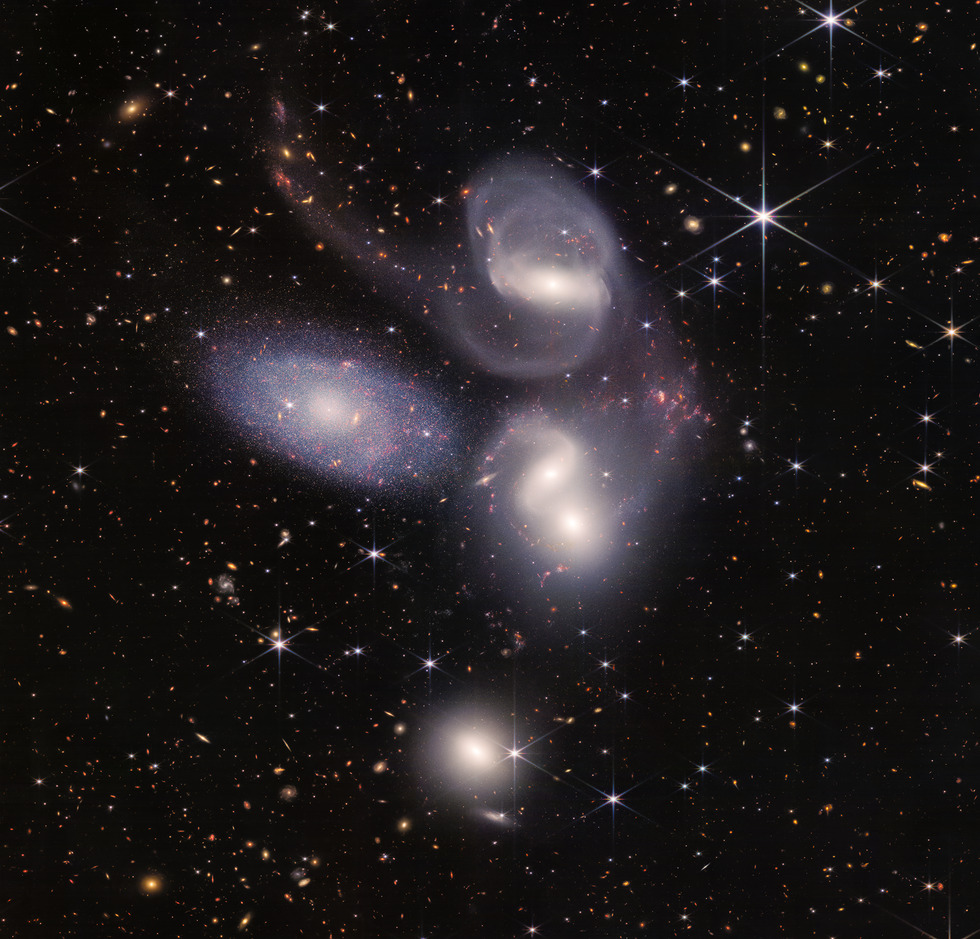
這個世界的諸多天然元素是怎麼來的呢?
這從星系的碰撞所釋放的巨大能量,可以看到其端倪。
星系碰撞中的氣體,產生新的星球,而這些星球承受不了自身內在太大的壓力,續而爆裂成星雲。
宇宙中本來比較多的元素是氫還有一點點的氦。
星系碰撞所釋出的巨大的能量,使得氫開始融合成更重的其他元素。
星球爆炸成星雲順利發展之下,燃燒氫而變成氦。氦再燃燒變成碳,碳變成氧,氧變成氖,然後依次再變成鎂、矽、硫、氬、鈣、鐵。大爆炸把這些元素拋到太空中,有些聚成麈粒——碳的石墨顆粒,砂狀由氧和矽結合而成的矽酸鹽聚合物,鐵顆粒等等。星系互撞初期形成的塵粒狀態,數量豐富,因為初生的星球是巨大的,迅速演變,在爆炸為星雲之前,已經產生了很多相關的元素。
原來只要能量足夠,所有的元素可以從氫這佃第一元素逐漸融合產生的啊!
節錄一段“The Universe, A Biography” 中一段相關的內容,供大家參考於後:
Collisions between galaxies cause the galaxies to get brighter. This moved the life of the Universe on from the Dark Ages towards the Cosmic Dawn.
星系碰撞會使它們變得更亮。這使得宇宙中的生命由黑暗時代走向光亮的黎明。
During the mergers of galaxies, stars do not collide because they are small and well separated, but clouds of interstellar gas are bigger and do. Gas at the collision interface is squashed. In especially dense regions, gas in the cloud collapses to form stars. If in an image we catch two galaxies colliding, the new stars show as clusters of stars that are bright, hot and blue, with the surrounding gas excited by ultraviolet starlight glowing brightly as a jumble of nebulae. Such an event is known as a starburst (pl. VI). Looking across the whole population of stars in a galaxy, astronomers can identify epochs when starbursts happened, each one triggered by a succession of collisions. The life of a galaxy and its stars is marked by these active episodes.
星系合併的過程,其中散佈的星球因為相對小又分開得夠遠所以不會互撞,但星際之間氣體所形成的雲則會。氣體在碰撞面壓縮。尤其在密度比較高的地區,氣體雲坍塌而形成星球。從兩個星系互撞的影像中我們可以看到,新的星球接著就出現了,當星群顯得特別明亮、高熱而呈現藍色,它附近的氣體被紫外線星光擾動而發亮有若是一個巨大的星雲。這個現象叫做星爆。觀察一個星系中所有星球的整體數量,天文學家就可以指出星爆發生的時期,每次都是在碰撞之後所觸發的。星系和星系中星球的生命期,就是由這些一連串的活躍事件所展現出來的。
Shortly after each starburst – perhaps tens of thousands to millions of years after – the newly born stars begin to explode as supernovae, so there is a sudden wave of supernova explosions.
緊接著星爆之後,或許是萬年到千萬年之後,新誕生的星球開始爆炸為星雲,所以會突然發生一波的星雲爆炸。
There might be as many as one hundred times more supernovae than usual – one per year in a galaxy rather than one per century. The stars that explode as supernovae are well developed in their evolution and have progressed beyond the burning of hydrogen to helium. They have been burning helium to carbon, carbon to oxygen, oxygen to neon, and so on to magnesium, silicon, sulphur, argon, calcium and iron. The explosion spreads these elements into space where some condense to make dust particles – graphite particles of carbon, sand-like material made of silicate compounds with silicon and oxygen, iron particles and so on. The dust made in the early colliding galaxies was formed in abundance because the first stars were large, evolved rapidly and made lots of the relevant elements before exploding as supernovae. The dust cloaked the light and heat from the remaining stars. It absorbed the light energy and so it became hotter. It emitted infrared radiation, which can be detected by infrared-sensitive telescopes. Microwave radiation with wavelengths in the millimetre range also carries heat from warm things like dust grains: millimetre-wavelength radiation like this can be detected by the ALMA telescope in Chile. ALMA has been able to detect galaxies densely covered by dust so opaque that they cannot be seen at all by the Hubble Space lelescope.
可能會比平時產生高達百倍的星雲,單一個星系每一年就發生一次,而不是每一百年才發生一次,星球爆炸成星雲順利發展之下,燃燒氫而變成氦。氦再燃燒變成碳,碳變成氧,氧變成氖,然後依次再變成鎂、矽、硫、氬、鈣、鐵。大爆炸把這些元素拋到太空中,有些聚成麈粒——碳的石墨顆粒,砂狀由氧和矽結合而成的矽酸鹽聚合物,鐵顆粒等等。星系互撞初期形成的塵粒狀態,數量豐富,因為初生的星球是巨大的,迅速演變,在爆炸為星雲之前,已經產生了很多相關的元素。那些塵粒遮罩了其他星球所散發的光和熱,吸收了光的能量,提高了自身的溫度,發射出紅外線輻射,可以被對紅外線敏感的望遠鏡觀察到。𨤳米級波長的微波,也會從發熱的塵粒帶走熱量,而這種𨤳米級波長的輻射可以被設於智利的ALMA天文望遠鏡偵測到。ALMA 天文望遠鏡可以偵測佈滿麈而顯得黑暗不清的星系,而那是Hubble 太空望遠鏡所望塵莫及的。
Another effect of the collisions is that the motion of stars and gas in each galaxy is disturbed. Stars and gas no longer orbit the centre of their galaxies in near-circles and the galaxy loses its circular symmetry. If it is a spiral galaxy, it may develop a central ‘bar’ of stars, with its spiral arms starting at each end of the bar (see page 103). Individual stars and streams of gas become redirected into orbits not only around the galaxy in circles but also passing in and out of the galaxy. This raises the possibility that they will pass near to the galaxy’s central supermassive black hole. The pull of the black hole on the nearer side of a star is greater than on the far side and is a tidal force (see page 113). The star may disrupt and its material will join back into the interstellar gas stream flowing onto the black hole.
星系互撞的另外一個效果就是在各別星系中的星球和氣體的運行都受到擾動。星球和氣體不再繞著原星系中心近圓形的軌道運行,而且星系不再呈現圓形對稱的形狀。如果它是螺旋狀的星系,它會產生一個棒狀的中心,旋轉臂由棒狀中心的兩端往外伸出。個別的星球和氣流會進入新的軌道,不再只都繞著星系中心的外圓,而是有些往中心移,但有些則往星系之外移動。這增加了它們接近星系中心超重力黑洞的機率。超重力黑洞對近端的星球的拉力比遠端的強,就猶由海浪的力量一般。星球可能瓦解,它碎裂的物質會和星際之間的氣流一起移動到黑洞𥚃面。
Black holes do not mind what they eat to make a quasar. Like lions and crocodiles in the Serengeti Park in Tanzania waiting for the tide of wildebeest, impala and zebra on their annual migration, they gorge on anything, usually gas and dust, but ‘spaghettified’ stars (see page 113) are tasty, too. If such a star drops onto a black hole at the centre of a galaxy, more mass than usual flows towards the quasar in a process called accretion. The flow may often be so great that the black hole cannot swallow it all at once and the material from the disrupted star circles round the black hole in an accretion disc, gradually leaking through onto the black hole itself. The increased mass flow onto the black hole causes the quasar to brighten. The brightening is episodic as extra-big lumps drop into the accretion disc and then into the black hole, so there are short outbursts as well as an overall longer increase of power output. The effects become visible as a bright flaring quasar.
黑洞會產生類星雲,它們不挑食,像獅子和鱷魚在坦尚尼亞的Serengeti Park等待一波波年度遷徙中的牛羚、黑斑羚、斑馬,黑洞什麼都吃,通常是氣體和塵粒,而被重力撕裂的星球對它也是很美味的。如果這樣的星球落入星系中央的黑洞,流向類星雲的質量會異常增加,這個現象叫「吸積」(accretion)。這個流量經常超過黑洞吞噬的能力,星球撕裂的物質就繞著黑洞的周圍形成一個吸稹的圓盤,逐漸向黑洞釋放。增加流入黑洞的質量點亮類星雲。類星雲不定時變亮,每當額外的塊狀物落入吸積的圓盤然後接著會進入黑洞,所以會有𣊬間的爆炸,也會在長期整體出現更高的能量輸出。看到的效果就是明亮的燃燒類星雲。
If not all, then nearly all galaxies have a central supermassive black hole. If two galaxies merge, the merged galaxy has two black holes. There are some galaxies, such as NGC 6240, that have a double nucleus, a bright spot of radiated energy coming from two black holes, each drawing in surrounding material. The supermassive black holes are separately eating gas and stars.
縱然不是每個星系都有,但幾乎所有的星系都有一個中央超重力黑洞。當兩個星系合併,合併的星系會有兩個黑洞。有些星系,譬如NGC 6240,有雙核心,發亮的位置是源自兩個黑洞的輻射能,每個黑洞都不斷吸收附近的物質。兩個超重力黑洞各自吞噬著星系中的氣流和星球。
In further interactions with the stars and the other black hole, each black hole approaches the other, dining together in close company, then they eat each other. The two black holes gravitate together and orbit each other making a binary black hole pair, stirring up and consuming gas and stars that wander nearby. As they orbit, they radiate gravitational waves. The black hole binary system loses energy and its orbit speeds up, causing gravitational radiation at an increasing power. This lasts for tens or hundreds of millions of years, with the two black holes drawing ever closer.
黑洞與星球以及另外一個黑洞的進一步互動中,兩個黑相互靠近,共伴各噬,然後開始互相吞食。兩個黑洞重力相吸,繞著對方轉,配對形成雙黑洞,擾亂並吞噬附近的氣流和星球。雙黑洞系統失去能量,相互繞轉的速度變快,重力輻射的能量不斷變大。這會持續千年甚至億年,兩個黑洞愈拉欲近。
There is a quasar, OJ 287, which seems to have reached this state. For the last 130 years at least, it has been giving a double burst of light every 11-12 years. One interpretation of what is going on in OJ 287 is that it is a binary black hole pair, so close together that they appear to us as one bright nucleus in a much fainter, merged galaxy. The orbital period of the smaller one around the larger one is twelve years. Twice per orbit the smaller smashes through the accretion disc around the larger, the collision and the brief meal making a double flash.
有一個類星雲,OJ 287,似乎已經達到了這種狀況。至少在過去130年之中,它每11-12年就會爆出加倍的亮度。對OJ 287的一種解讀,它是一個兩個星系合併而成的雙黑洞成對系統,兩個黑洞的距離很近而其中的一個核心比較暗,所以看起來好像是只有單一核心的亮點。比較小的黑洞繞行比較大的黑洞的公轉軌道一圈是12年。每圈小的黑洞會有兩次撞過大的黑洞的吸積碟,短暫的衝撞產生了加倍亮度的閃光。
Eventually the two black holes get so close that they merge in a frenzied, but silent, crescendo of gravitational wave energy. After a very long build-up, the final merger is quick, with prodigious amounts of energy, radiated in a brief burst. The burst could be detectable from right across the Universe, given the right gravitational wave detector. Like radio antennas, gravitational wave detectors are of different sizes according to the frequency range at which they operate: small antennas are sensitive to short waves, namely those of high frequency. Terrestrial gravitational wave detectors like LIGO (see page 172) operate at the wrong frequency range to pick up merging supermassive black holes because the detectors are too small (less than the size of the Earth). Detectors in space can be much bigger (as described on pages 265-66, the space-borne gravitational wave detector eLISA is planned to be six times as big as the Earth-Moon distance) and will be able to see these events.
最終那兩個黑洞會變得非常接近,在無聲但逐漸增強的重力波能量之下劇烈合併。經過很長時間的營造,最後階段的合併則是快的,驚人的能量,輻射爆發出來。這種爆發,只要有重力波的偵測器,可以從宇宙中偵測出來。像無線電天線,重力波偵測器有各種不同的大小依相對的頻率範圍而定:小的天線能偵測的是短波,也就是高頻的。地表上的重力波偵測器如LIGO,它適用在不對的頻率範圍,無法偵測到合併中的超重力黑洞,因為那個偵測器太小(小於地球的大小)。太空中的偵測器可以大很多(如265-66頁所述,計劃中的太空重力偵測器eLISA是地球到月球距離的六倍。),那麼就可以偵測到星系合併的超重力波了。
It seems likely that events from merging supermassive black holes will also produce other forms of radiation, like X-rays and radio waves. The gravitational waves themselves scarcely interact with matter, and little of their energy is directly converted via matter into light and radio waves. However, matter accreting onto the black holes is violently disturbed and radiates in a way that is correlated with the gravitational waves. With attention drawn to a merger event by detection of the gravitational waves, together with some information about the direction from which it comes, derived from the orientation of the detector, astronomers may be able to track the event down to the galaxy in which it appears. Of course, if the galaxy is already recognized to contain two black holes it will be easier to do this. For OJ 287, one theory predicts that the ultimate merger will happen in about ten thousand years, so there is no urgency to get ready. eLISA could well detect between ten and one hundred mergers of supermassive black holes per year, out to a distance of 12 billion light years, with in addition 10 per cent of them detected as X-ray and radio sources. These events provide opportunities for wonderful multi-messenger astronomical investigations that the eLISA scientific teams are planning (see Chapter 13).
似乎超重力黑洞的合併會產生其他種類的幅射,譬如X光和無線電波。重力波幾乎不跟物質產生作用,它的能量很很少透過物質轉換成光或無線電波。但是,重力波吸積到黑洞的物質受到激烈的擾動而散發出來的幅射則和重力波相關。透過偵測重力波可以循線找到合併黑洞的事件,加上由偵測器的方位推導出來的重力波來源方向的資訊,天文學家可以找到發生該事件的星系。對OJ 287,這個系統,有一個理論預測黑洞合併終將於約一萬年後完成,所以也不急。eLISA每年可以偵測10到100個超重力黑洞合併,最遠達到120億光年的距離,加上另外10%的發現是透過X光和無線電波源的偵測。這些事件提供了機會,很棒的多種媒介的文調查研究,而這正是eLISA科學小組所計劃為之的。
Extra energy is liberated by the collision, by the newly born bright blue stars in the starburst, by the supernovae that they make, by the quasar outbursts and by black hole mergers. It is considerably more than normal starlight. It has a profound long-term effect on the development of the merged
星系互撞釋出出額外的能量,透過星爆新產生的亮藍色星球,透過超新星的產生,透過類星雲的爆發和黑洞的合併。這些能量比純粹的星光還多。它對星系合併的發展,有很深遠長期的影響。
*:Paul Murdin,”The Universe, A Biography,” 2022, Thames & Hudson Ttd, London
P.S. 相片:哈柏天文望遠鏡攝的「史蒂芬五重星系 Stephan’s Quintet」,預期在很遙遠很遙遠的未來,這五個星系會合併為一個(~「NASA發布「韋伯太空望遠鏡」壯麗絕美全彩宇宙照!超震撼「全彩星雲、車輪星系、木星美照」免費下載」,Edit by Candy Chung, and text /Kai Chao , 2022/09/06)
2023/2/20 世界的各種天然元素是怎麼來的 Damakey
