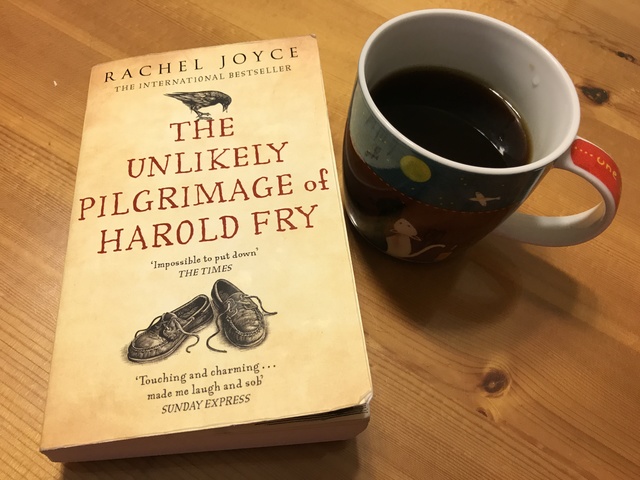
「Harold passed office workers, dog walkers, shoppers, children going to school, mothers and buggies, and hikers like himself, as well as several tourist parties. He met a tax inspector who was a Druid and had not worn a pair of shoes for ten years. He talked with a young woman on the trail of her real father, with a priest who confessed to tweeting during mass, as well as several people in training for marathon, and an Italian man with a singing parrot. He spent an afternoon with a white witch from Glastonbury, and a homeless man who had drunk away his house, as well as four bikers looking for M5, and a mother of six who confided she had no idea life could be so solitary. Harold walked with these strangers and listened. He judged no one, although as the days wore on, and time and places began to melt, he couldn’t remember if the tax inspector wore no shoes or had a parrot on his shoulder. It no longer mattered. He had learned that it’s was the smallness of people that filled him with wonder and tenderness, and the loneliness of that too. The world was made up of people putting one foot in front of the other; and a life might appear ordinary simple because the person living it had done so far a long time. Harold could no longer pass a stranger without acknowledging the truth that everyone was the same, and also unique; and that this was the dilemma of being human.」(~”The unlikely pilgrimage of Harold Fry,” by Rachel Joyce)
Harold received a letter from an old colleague, Queenie, who departed abruptly 20 years ago and had never met him ever since. The letter read that Queenie got serious cancer and doctor said there is no anything else can be done to further cure the disease.
It’s a life and death goodby letter.
Harold had already had a family already and he originally would like to reply by a polite letter, but he had been hesitating to mail it out while walking around the town bypassing several post boxes.
Later on he decided to visit Queenie in person instead.
A young girl who sold him a hamburger told him that her aunt had ever had cancer. She said as long as we could have strong positive belief, the body would cure itself automatically.
Harold informed Queenie to wait for him. He believed Queenie would endure and survive by hope of seeing him. To show his strong belief and to wish Queenie could live longer, he decided to go from Kingsbridge to Bertwick by walking.
It took 87 days by walking 627 miles for Harold to complete the journey from south to north England.
He met all kind of friendly and helpful people along the way and he kept thinking about his own dark past as well.
At the beginning I thought the book is about a pilgrimage for romantic love. After having scanned through those pages, I was surprised to find that it’s more about the meaning of life.
To read through the book is like to relive a twisted life of a struggling person, his thoughts, reflections and inspirations.
“… everyone was the same, and also unique; and that this was the dilemma of being human.” How true it is!
It’s worth of reading. Anyway.
2017/7/9 “The unlikely pilgrimage of Harold Fry” Damakey